Sic Itur Ad Astra – Thus The Way To The Stars : 144 years of astronomy
If you can see this message then you are using a browser (probably Internet Explorer) which does not support the international web standards used by the LAS website and many others. Click here for an example of how the site should look.
Please consider using an alternative browser - especially if you are on Windows XP which only supports the outdated Internet Explorer 8 browser - such as Mozilla Firefox or Google Chrome which do have support for these web standards. As well as not supporting modern features and web standards, old versions of browsers - especially Internet Explorer - can expose your computer to security risks. The Browse Happy website has a list of the latest versions of all major browsers, including Internet Explorer (but remember Windows XP only supports up to IE8!)
If updating/changing your browser is not possible, do not panic - all of the LAS website is still available to you and we are working to make the layout compatible with outdated browsers.
Miss Sarah Gilligan, a member of Liverpool Astronomical Society, was awarded the runner-up prize in the first Young Astronomy Photographer of the Year competition.
The competition was organised by the Royal Observatory Greenwich, and the BBC’s Sky at Night Magazine as part of International Year of Astronomy 2009. Continue reading →
David Forshaw entertained us with an intriguing and thought provoking account of the mystery of time;. Commencing with an apt quotation from a book by G J Whitrow, “…Only time has this peculiar property which makes us feel intuitively that we understand it perfectly so long as we are not asked to explain what we mean by it…”
Some suggest time is like a fluid, others a series of linked atomic particles. Our sense of time is based entirely on our perception of it on this planet of ours.
The question :- “How long is a second?” was raised. Very short seconds were referred to , e.g. the nanosecond (0.000,000,000,1 second) and even the femto second , 10 to the power minus 24, a so called atom of time or “chronon” – the time it takes for light to cross the distance of a proton from an electron.
The audience was asked to take part in a little experiment, namely to count up to a minute in their heads giving a signal when in their estimate this had been reached. As expected some were very close to the correct time and there was a scatter of slower and faster results. Could the faster people be more impulsive? and the slower more contemplative? Experiments conducted with two men spending nearly five months in underground caves were found after two weeks to have greatly underestimated time’s passage.
Some birds only migrate at night. No particular stars appear to be involved in their direction finding ability, but only the general pattern of the night sky. In the daytime the elevation ofthe Sun, its position, and the length of daylight hours contribute to birds navigational skills.
Music and the length of a second were then discussed, mentioning how in some pieces of classical music with differing lengths of silences between chords, different sections of the orchestra could come in fractionally out of phase with others. Samples of Sibelius’ 5th symphony and a Beethoven string quartet were played to illustrate this.
The significance of 60 seconds in a minute and 60 minutes in an hour were discussed. The Babylonians responsible for this method of time division noted that 60 was the smallest number that was divisible by 2,3,4,5, and 6. Various other calendars were referred to including the Egyptian, Mayan, Sanscrit and Roman systems.
The length of the year was discussed with the interesting finding that it varies slightly in length depending on whether it is estimated from the equinoxes or solstices, the average being 365.24219 days this being the current average length of our tropical year. This is not the same as the sidereal year which is some 20 minutes longer due to precession. The equation of time was then explained as being the resultant of the Sun travelling along the ecliptic rather than the celestial equator, coupled with the eccentricity of the Earth’s orbit. To make things more complicated, as a result of tidal drag, the Earth was slowing down by degrees. Studies of growth bands on fossil corals suggest that 600 million years ago the day was 21 hours long. All these factors were contributing to the difficulty in estimating the length of a second.
Relativity was drawn into the equation “with some trepidation”
Time slows down for people travelling at close to the speed of light, and even jet airliners travelling at less than one millionth the speed of light experienced a slowing of time equal to 59 nanoseconds going east and 273 nanoseconds going west., the difference caused by the Earth’s rotation to the east.
Finally, whilst consuming a leisurely meal in a French rural setting, the various courses lovingly described by David, he observed hundreds of swifts chasing after insects and started to ponder over whether time scales for different species operated at different wavelengths to our own, Another short experiment, namely asking the audience to estimate a fraction of a minute (48 seconds) brought the proceedings to a close.
This interesting talk was very well received. It was followed by the cheese and wine reception during which the effort Chris and Tricia Banks had put into preparing this sumptuous repast was gratefully acknowledged.
Continuing on from last month let’s look at how some more of the more obvious constellations and stars can be used as pointers and sign posts in the night sky. Let’s go back to the Plough which is part of the constellation Ursa Major, the Great Bear. The 2 pointer stars point towards Polaris, the pole star. This is not a bright star. It’s significance is it’s location rather than it’s brightness. It is the star that is above the North Pole so is always a pointer to the north Passing straight past Polaris will take you to Cassiopeia, a W or M shaped constellation. See the chart below and pass through Polaris to Cassiopeia. The stars of Cassiopeia are not too bright but it is quite easy to identify the shape of the constellation.
Using The Plough and Polaris to find Cassiopeia. (click to enlarge)
Now look south, the constellation of Orion dominates the night sky in the winter. Next month we’ll explain the movement of the sky and why different constellations appear in Spring, Summer, Autumn and Winter. But as this is December’s issue we must mention the great Hunter, Orion.
Looking towards the south, look for the pattern of stars below. You’ll probably find the 3 stars of the belt first.
Star Chart: Orion, the hunter (click to enlarge)
Depending on light pollution you may only find the brighter stars. The 3 stars almost in a row are Orions’ belt. Below that are his sword and within the sword is the Orion Nebulae M42. Click the link for more information http://en.wikipedia.org/wiki/Orion_Nebula
As a guide Orions’ belt is about 3 degrees from each end star, Altinak and Mintaka .
Diagram: Common sky measurements with hands (click to enlarge)
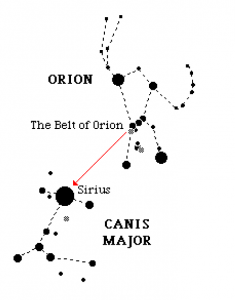
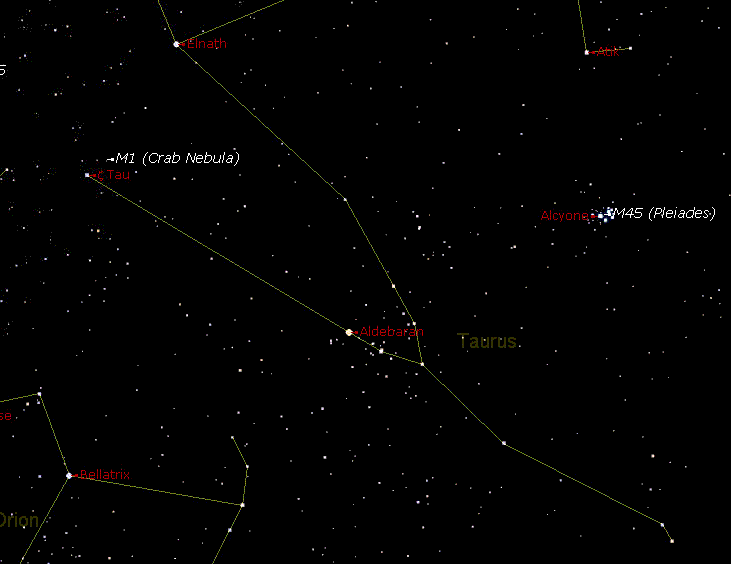
From Orion it is a simple hop to Taurus using the 3 belt stars as pointers or in the opposite direction to find Sirius, the brightest star in the sky.
Star chart: Using Orion’s belt to find Sirius
Star chart: Using Orion’s belt to find Alderbaran (click to enlarge)
We’re starting a new feature for those members new to astronomy. This month to start you off we have “Getting started in astronomy”, a guide to those “first steps” in astronomy and a view of some key constellations of the northern skies. Plus “Constellation of the month”, a closer view at Andromeda this month.
Stars appear to be scattered across the sky and how can you ever make any sense of them. And
which ones are planets, how do you find them. In the northern skies there are about 2,000 stars viewable up there with your naked eyes. But most of us may be able to see 200 maximum due to town light pollution blotting out the fainter stars.
The first things to think about are where shall I observe and what do I need to take outside with me.
Find somewhere safe and away from street lights directly shining on you. If you can find a safe site away from street light that is even better. Back gardens are a good starting place. Do go outside and don’t just look through windows. Give you eyes 15-20 minutes and you’ll begin seeing a lot more. You’ll need to keep warm and comfortable so anything from warm clothes to a comfy outside chair or even deckchair could be used.
You don’t need heavy expensive equipment just a planisphere, ( check Phillips Planisphere at Amazon.co.uk) decent astronomy book (Collins Gem Night Sky) and a pair of binoculars (10×50 are ideal). You’ll also find that decent stores such as Waterstones will stock Planispheres and Collins Night sky book.
Scale in the sky: A fist held out at arm’s length is a convenient measure of angular size in the sky. Here a fist is shown in comparison with the seven stars of the Plough (or Big Dipper) in Ursa Major.
I’m going to assume you know how to locate the Plough (above). This is a great starting point for your night of star gazing. The plough is a part of the constellation of Ursa Major but is easy to find and is a great signpost looking north. We measure the distance between stars as we see them from Earth in degrees, minutes and seconds. More of that later.
Now let’s use the various signposts of the Plough to help you move to other constellations. Look for the 2 pointer starts that will take you to the North Star, Polaris and onwards to Cassiopeia. Going in the opposite direction takes you to the constellation of Leo and the backwards question mark, “The Sickle”. Back to the Plough and follow the handle of the Plough and “arc” to the star Arcturus in
the constellation of Bootes. Continuing past takes you to Spica which is the brightest star in Virgo.
Use your planisphere to look around the main stars and find Andromeda, near Cassiopeia, maybe even find M31 with your binoculars. Don’t forget to look at your Night Sky book too.
By using your hand you can gauge the distance in degrees between objects. Your fist held out at arms length measures about 10 degrees. Also at arms length the width of your index finger is 1 degree and the middle 3 fingers together is about 5 degrees.
Taurus is one of the oldest zodiacal constellations. According to myth, Taurus represents the bull form taken on by Jupiter or Zeus in pursuit of the fair maidens of the seven sisters (Pleiades). There are several stories about this constellation and the lusty ancient gods!
Objects in Taurus
Taurus lies adjacent to Orion and will be seen in the South during December.
Most famous object in Taurus is the lovely Pleiades open star cluster (also known as M45). This a beautiful naked eye open cluster object. Use binoculars for really good views.
For more information click on the link; http://en.wikipedia.org/wiki/Pleiades
Other delights are the Crab Nebulae which is the remnants of a supernova explosion that the Chinese and Arab astronomers recorded around 1054AD. This is also known as M1 and is about 6,500 light years away.
Click below for more information and images of M1, the Crab Nebulae. http://en.wikipedia.org/wiki/Crab_Nebula
Also, look for the “V” shape of Hyades open cluster which is the closest star cluster to Earth. This can be found near the bright star Aldebaran. There is another mythical story about the Hyades being the daughters of Atlas.
Aldebaran, (Tau alpha) is a huge red giant star many times larger than our own sun and represents the eye of the bull. See the diagram below.
Albebaran’s diameter is 44.2 times that of the Sun. Image credit: Wikimedia Commons (click image to enlarge)
The “Ghost of Mirach” galaxy is shown in visible light on the left, and in ultraviolet on the right. The fields of view are identical in both pictures, with the Ghost of Mirach – a galaxy called NGC 404 – seen as the
whitish spot in the centre of the images.
Mirach, β-Andromeda, is a red giant star that looms large invisible light. Because NGC 404 is lost in the glare of this star, it was nicknamed the Ghost of Mirach. But when the galaxy is viewed in ultraviolet light, it
comes to “life,” revealing a never-before-seen ring.
This ring, seen in blue in the picture on the right, contains new stars – a surprise considering that the galaxy was previously thought to be, essentially, dead. Before this image in the ultraviolet NGC 404 was
thought to contain only very old and evolved red stars distributed in a smooth elliptical shape, suggesting a galaxy well into its old age and no longer evolving significantly.
The field of view spans 55,000 light years across. The Ghost of Mirach is located 11 million light-years from Earth. The star Mirach is very close in comparison – it is only 200 light-years away and is visible with the naked eye.
The visible data come from the Digitized Sky Survey of the Space Telescope Science Institute in Baltimore, Md.
The constellation of Auriga culminates, reaches its highest point in our sky, at about midnight in mid December.
However, even at about 21:00, in mid December, it is about 60 degrees above the horizon and conditions should be excellent for finding the 3 bright star clusters included in Charles Messier’s 18th century list of comet like objects;
M36 (RA 05:36, Dec +34:08 epoch 2000)
M37 (RA 05:52, Dec +32:33)
and
M38, (RA. 05:29, Dec +35:50).
People often ask me if their alignment in the sky follows a simple east/west pattern, i.e., do you go west to east, or east to west as you go from M36 to M37 to M38? Unfortunately, as ever, life is not that simple.
Going from west to east the sequence is M38, M36 then M37. Why? Well, only one of these objects, M37, was discovered by Messier, in 1764. The other two were discovered by Le Gentil, (his full name is a lot longer than this!), in 1749.
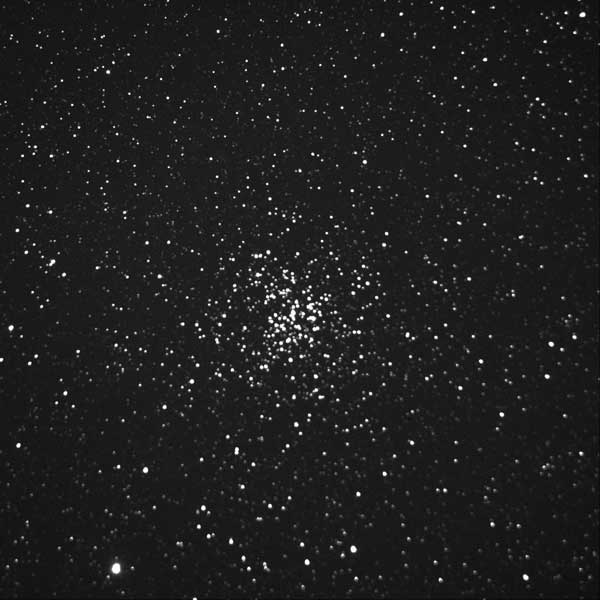
Perhaps Messier was trying to emphasise that there is something different about M37. Is there? I think so. M36 and M38 were discovered first. This is almost certainly because they are easier to see in very small telescopes. They are only about 2.25 degrees apart and although M38 is bigger, they both consist of fairly bright stars that are easily resolved in very small telescopes.
M37 is almost 4 degrees from the middle cluster of this trio, M36. It is also much more comet like, in small telescopes, than the other two. There are very few bright starsin M37 but it is very rich in faint stars. In the 16 inch Robertson Reflector, at Pex Hill, it never fails to provide a stunning view, even at low power. The other two clusters are best appreciated with smaller telescopes or binoculars.
(Note by MG, 11th May 2013: The prices quoted in this article were accurate as of December 2008 but will likely have changed by now! It’s possible some of the prices given will have dropped as new brands/models have become available in the intervening time.)
If you’re new to astronomy and you’re thinking of buying your first telescope for Christmas then this article should help you choose an appropriate instrument. Continue reading →