My introduction to Astronomy, by John Williams of Little Neston

Listening to Steve Southern at the first session of 2008-2009 and his introduction to the new electronic issue of the News Letter, he stressed the fact that it really is the member’s paper and we were all encouraged to contribute to  its production, such articles would be welcomed by the editors. He said, for example, “when and how did you first find an interest in astronomy”.

I was about 8 years old when my father called me out into the back yard and pointed up to the sky, “that silver glow you see is called the Milky Way” he said. This was in a very small house in Walton not more than 400 yards from Everton’s football ground and the year was probably 1934; I was impressed when he told me it was made up of millions of stars. Now, I wander where he learned that, he was not a reader, there was no Discovery Channel and the ‘wireless’ was not the best medium in those days for conveying information on scientific subjects.

On another occasion he called me out again to show me a wonderful Aurora Borealis, beautiful reds, oranges and greens. He was a lovely Dad, he taught me so many things. I have seen a couple of Aurora’s since, but not as striking, one from a plane flying from Gander to Prestwick the week after 9/11 and another, two years ago in Bergen with my son, on an 80th birthday trip, a
present from him and his fiancé.

I saw the Milky Way several times when stationed with the garrison in Malta in 1945, there was no light pollution at all at that time. I imagine it will be very different now.

On our 25th wedding anniversary, my wife bought me a telescope because she knew of my interest, it was a 70mm refractor, from Dolland & Aitchison, not knowing the difference between a telescope and a teapot, she had her friend Margaret Mitchell go with her to choose it, Margaret was for a time treasurer of the LAS and she and I often talked about astronomy, with my wife just looking bored. On two occasions Margaret took me to meetings, I think they were held in Colquitt Street this would be about 1975, sadly Margaret died four or five years ago.

Another very old friend was George Bundred who as Mayor of Knowsley had a lot to do with the Pex Hill project, and I believe was present at the official opening of the observatory with Sir Patrick Moore.

After putting off joining the Society for years, I finally made the journey to the Museum about 10 or twelve years ago and was made very welcome by the many people who I have come to know. I am still not very good at observing, but get a lot of encouragement from so many members particularly John Knott. One evening at his home with our Patron Mr Stephen Hughes for company, we made copies of the folio of Moon maps, kindly made available by Dr Eric Jones.

To conclude, a cheering sight on my way to the meetings is the sign outside one of my locals, ‘The Seven Stars’, in Thornton Hough.
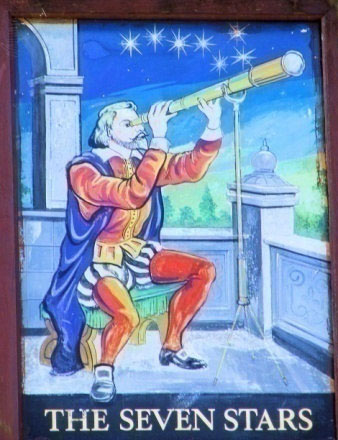
The sign of The Seven Stars pub, Thornton Hough, Wirral, Circa 2008

The sign of The Seven Stars pub, Thornton Hough, Wirral, Circa 2008

Constellation of the Month (November 2008) – Andromeda, by Steve Southern

Diagram: The constellation of Andromeda (showing M31)

High in the south at midnight in November is the wonderful constellation of Andromeda. Look for it almost directly above you towards the South at around midnight during November. Click for printable map http://www.hawastsoc.org/deepsky/and/and.html

Myth

Andromeda is the Greek daughter of Queen Cassiopeia and King Cephus of Ethiopia. Andromeda was very beautiful making Hera, wife of Zeus, very jealous. Poor Andromeda’s fate was sealed when she was sacrificed to the sea-monstor, Tiamat (shown in thesky as Cetus) but like all good maidens she was saved by a handsome prince, Perseus on the back of Pegasus, the winged horse. Objects in Andromeda Most famous object is our next nearest galaxy (2.2 million light years away) M31, the Andromeda galaxy. Click for image http://apod.nasa.gov/apod/ap021021.html

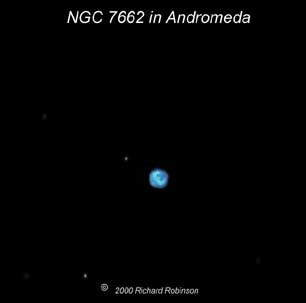
Planetary nebula NGC 7662 (often called "The Blue Snowball") in Andromeda, imaged by Richard Robinson in 2000

Planetary nebula NGC 7662 (often called “The Blue Snowball”) in Andromeda, imaged by and courtesy of Richard Robinson, in 2000

Planetary nebula NGC 7662 (often called “The Blue Snowball”) in Andromeda, imaged by (and courtesy of) Richard Robinson in 2000

Other galaxies in Andromeda are M32, M110. Other objects include the Blue Snowball, NGC7662. Also look for Almach at the end of the star chain, a lovely double-star system of gold and blue.

Getting started in Astronomy (Part 1), by Steve Southern

We’re starting a new feature for those members new to astronomy. This month to start you off we have “Getting started in astronomy”, a guide to those “first steps” in astronomy and a view of some key constellations of the northern skies. Plus “Constellation of the month”, a closer view at Andromeda this month.

Stars appear to be scattered across the sky and how can you ever make any sense of them. And
which ones are planets, how do you find them. In the northern skies there are about 2,000 stars viewable up there with your naked eyes. But most of us may be able to see 200 maximum due to town light pollution blotting out the fainter stars.

The first things to think about are where shall I observe and what do I need to take outside with me.
Find somewhere safe and away from street lights directly shining on you. If you can find a safe site away from street light that is even better. Back gardens are a good starting place. Do go outside and don’t just look through windows. Give you eyes 15-20 minutes and you’ll begin seeing a lot more. You’ll need to keep warm and comfortable so anything from warm clothes to a comfy outside chair or even deckchair could be used.

You don’t need heavy expensive equipment just a planisphere, ( check Phillips Planisphere at
Amazon.co.uk) decent astronomy book (Collins Gem Night Sky) and a pair of binoculars (10×50 are ideal). You’ll also find that decent stores such as Waterstones will stock Planispheres and Collins Night sky book.

Scale in the sky: A fist held out at arm's length is a convenient measure of angular size in the sky. Here a fist is shown in comparison with the seven stars of the Plough (or Big Dipper) in Ursa Major.

Scale in the sky: A fist held out at arm’s length is a convenient measure of angular size in the sky.
Here a fist is shown in comparison with the seven stars of the Plough (or Big Dipper) in Ursa Major.

I’m going to assume you know how to locate the Plough (above). This is a great starting point for your night of star gazing. The plough is a part of the constellation of Ursa Major but is easy to find and is a great signpost looking north. We measure the distance between stars as we see them from Earth in degrees, minutes and seconds. More of that later.

Use the various signposts of the Plough to help you move to other constellations. Look for the 2 pointer starts that will take you to the North Star, Polaris and onwards to Cassiopeia. Going in the opposite direction takes you to the constellation of Leo and the backwards question mark, “The Sickle”. Back to the Plough and follow the handle of the Plough and “arc” to the star Arcturus in the constellation of Bootes. Continuing past takes you to Spica which is the brightest star in Virgo. Use a planisphere to look around the main stars and find Andromeda, near Cassiopeia, maybe even find M31 with binoculars.

Using the Plough as a signpost

Now let’s use the various signposts of the Plough to help you move to other constellations. Look for the 2 pointer starts that will take you to the North Star, Polaris and onwards to Cassiopeia. Going in the opposite direction takes you to the constellation of Leo and the backwards question mark, “The Sickle”. Back to the Plough and follow the handle of the Plough and “arc” to the star Arcturus in
the constellation of Bootes. Continuing past takes  you to Spica which is the brightest star in Virgo.

Use your planisphere to look around the main stars and find Andromeda, near Cassiopeia, maybe even find M31 with your binoculars. Don’t forget to look at your Night Sky book too.

By using your hand you can gauge the distance in degrees between objects. Your fist held out at arms length measures about 10 degrees. Also at arms length the width of your index finger is 1 degree and the middle 3 fingers together is about 5 degrees.

Using your hand to gauge distance in degrees

By using your hand you can gauge the distance in degrees between objects. Your fist held out at arms length measures about 10 degrees. Also at arms length the width of your index finger is 1 degree and the middle 3 fingers together is about 5 degrees.

Click here for Part 2 of this article


The Distance Learning in Astronomy Experience – Brian Finney

I have always had a passing interest in Astronomy and Space; about 15 months ago I decided to take it further and attended my first LAS meeting. As a part of this new venture I needed to move up the learning curve
quickly to take advantage of and maintain my new interest.

Looking around for the best way to move up the learning curve suggested that a Distance Learning course may be the answer. There is a plethora of courses that covers a wide range of astronomical subjects from three local academic organisations, John Moores University AstroPhysics Research Institute, University of Central Lancashire, Jodrell Bank Observatory and nationally from the Open University.

My thoughts have not gone to the more conventional route of personal telescope use and purchase – in fact I have come to the conclusion that I will not be purchasing a telescope, much preferring a computer with internet access followed by a warm bed rather than the vagaries and limitations of observing on cold clear nights. LAS’s Leighton Observatory at Pex Hill serves my very limited need to observe in person. This naturally led me to the ‘Universe through the Large Telescope’ course run by John Moores University Astrophysics Research Institute (JMU ARI).

The JMU ARI ‘Universe through the Large Telescope’ course is rated as a 240 hours course over about 6 months – approximately 10 hours a week, although I finished in a shorter time as the course became addictive and I easily and unintentionally put in more than the planned 10 hours a week. The cost is £240 for EU residents which I assume all readers will be. Other courses are 120 hours and cost £120. All course notes etc are provided on CD and internet access is necessary.

The outputs from the ‘Universe through the Large Telescope’ course are five projects or assignments to be submitted to deadlines; four projects being chosen from a list of seven and a compulsory project ‘The Liverpool
Telescope’. The projects are very well structured and you are lead through them, with tutor support by email or telephone, if you need it. I have to say that at first sight the project titles are overwhelming but it is surprising how quickly you become comfortable with them once you have started the first project and you realise that help and a route through is readily available in the notes associated with project and from the tutor.

Project or assignment titles include Distance to the Hyades Cluster, Orbital properties of Extra Solar Planets, Observations of Objects at Multi-wavelengths, Supernova 1987A and Cephid variables.

JMU ARI’s others courses are:

  • Exploring the Universe – an Introduction to Astronomy
    (starts October and April of each year) 24 Credit course
  • Galaxies
    (starts February of each year) 12 Credit Course
  • The Universe Through a Small Telescope
    (starts December and June of each year) 12 Credit Course
  • Astronomy for Teaching
    (can be taken from September to February) 12 Credit Course
  • Planetary Atmospheres
    (starts July of each year) 12 Credit Course
  • Modern Cosmology and the Distant Universe
    (starts May of each year) 12 Credit Course
  • The Universe Through A Large Telescope
    (starts July of each year) 24 Credit Course
  • The Science of Science Fiction
    (starts March of each year) 12 Credit Course
  • Planetary Geology
    (starts November of each year) 12 Credit Course
  • Stars
    (starts September of each year) 12 Credit Course

A few final thoughts, the course fulfilled its and my objectives in that it quickly moved me up the learning curve; and more than that it has increased my enthusiasm and given me enjoyment and satisfaction whilst exercising the grey matter. Therefore, money and time well spent in my opinion.

You may want to try a course that interests you.

Multi-wavelength Observing – November 2008, by Brian Finney

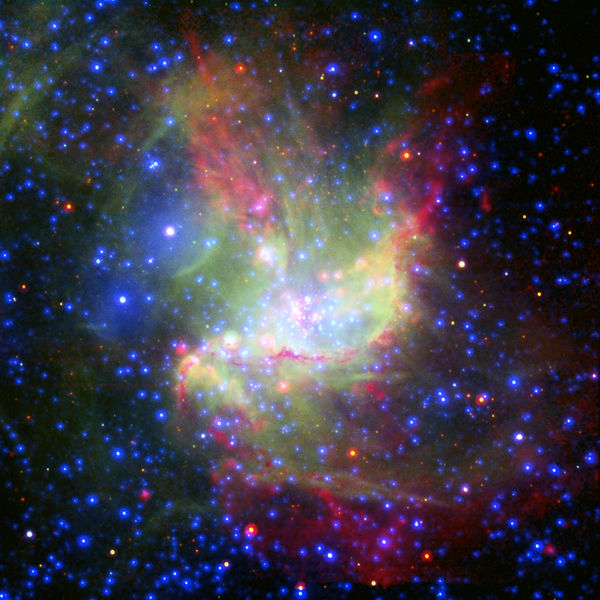
Following on from his article last month Brian Finney brings the latest news on Multi-wavelength observations with a portrait of a star-forming cloud, called NGC 346 which is the brightest star-forming region in the Small Magellanic Cloud.

The colour code is red for infra red wavelengths showing cold dust; green for visible wavelengths and blue for X-rays. Ordinary stars appear as blue spots with white centres while young stars enshrouded in dust appear as red spots with white centres. The following photograph and details come direct from and are attributed to NASA.

The bright star-forming region NGC 346

The bright star-forming region NGC 346

This portrait of a star-forming cloud, called NGC 346, is a combination of multiwavelength light from NASA’s Spitzer Space Telescope (infrared), the European Southern Observatory’s New Technology Telescope (visible), and the European Space Agency’s XMM-Newton space telescope (X-ray).

The infrared observations highlight cold dust in red, visible data show glowing gas in green, and X-rays show very warm gas in blue. Ordinary stars appear as blue spots with white centres, while young stars enshrouded in dust appear as red spots with white centres.

The colourful picture demonstrates that stars in this region are being created by two different types of triggered star formation — one involving wind, and the other, radiation. Triggered star formation occurs when massive stars spur new, smaller stars into existence. The first radiation-based mechanism is demonstrated near the centre of the cloud. There, radiation from the massive stars is eating away at the surrounding dust cloud, creating shock waves that compress gas and dust into new stars. This compressed material appears as an arc-shaped orange-red filament, while the new stars within this filament are still blanketed with dust and cannot be seen.

The second wind-based mechanism is at play higher up in the cloud. The isolated, pinkish blob of stars at the upper left was triggered by winds from a massive star located to the left of it. This massive star blew up in a supernova explosion 50,000 years ago, but before it died, its winds pushed gas and dust together into new stars. While this massive star cannot be seen in the image, a bubble created when it exploded can be seen near the large, white spot with a blue halo at the upper left (this white spot is actually a collection of three stars).

NGC 346 is the brightest star-forming region in the Small Magellanic Cloud, an irregular dwarf galaxy that orbits our Milky Way galaxy, 210,000 light-years away.

Deep Sky – November 2008 by Dave Owen

M34 / NGC1039

M34 / NGC1039

The constellation of Perseus is about 60 degrees high, and still rising, at about 21:00 GMT in mid November. This can mean  that  some  objects  in  this  constellation,  especially  with  Dobsonian  telescopes,  can  be difficult  to  see near  its passage through our zenith. Therefore, they can sometimes be seen more easily when they are still rising. Just as equatorial telescopes have a blind spot near the north celestial pole, Dobsonian telescopes can have ablind spot near the zenith. This is where steering and looking through these telescopes can start to get quite awkward.

The star cluster M34, (RA 02:42, Dec +42:47 epoch 2000), is one of those deep sky objects that I can sometimes see with the naked eye, in exceptional conditions. It is just under 1,500 light years away and is composed of a reasonable number of stars from about 8th to 10th magnitude. It presents no challenge to 7×50 binoculars, in terms of resolving the  individual stars. It is also not too difficult to find as it is about midway between gamma Andromeda and beta Persei, also known as Algol, the Demon Star. Telescopically, especially with larger telescopes, it can seem a bit disappointing
as  it  does  not  show  a  huge  number  of  stars  as  the  magnification  is  increased.  However,  for  small  telescopes, especially at low power, it is well worth trying to find.

Another star cluster in Perseus which is almost as bright as M34, and bears many similarities to it, is NGC 1528, (RA 04:15 Dec +51:14). If M34 is near the end of the left arm of Perseus, then NGC 1528 can be visualised as being near the end of the right arm. It is normally an easy sight in 7×50 binoculars, although not quite as easy as M34. However, telescopically, this object, to me, seems more interesting than M34. It is about twice as distant, over 2,500 light years away, and seems slightly richer. The individual stars are still relatively bright, compared to some ofthe more distant star clusters, but are about a magnitude fainter than the stars of M34. In my early days of observing,when I was using a 4.25 inch f3.5 reflector, magnifying about 17x, this was one of the objects I started to find beforeI got very far in seeing all of the 110 Messier objects. It is definitely easier to find than some of the more elusive Messier objects.

Adventures in Arizona, Rob Johnson


It could be said that Arizona is the world ‘capital’ of astronomy, with clear skies for much of the year and home to several major observatories it is an irresistible holiday destination. So my family and I visited this summer and combined holiday with astronomy to tour around some of the many places of astronomical interest.

First stop up was a 3-night stay at the Arizona Sky Village. The ASV is nestled in the remote south-east corner near New Mexico with some of the darkest skies in the world and consists of a grouping of homes ina highly protected area – no outdoor lights are allowed! Jack Newton, Fred Espenak and others have homes here. We hired the Green Witch house which is offered for rent by the UK company of the same name. We drove the 285 miles from Phoenix in about 6 hours through some beautiful countryside but before we set off we were warned there had been heavy rain in the area from the remnants of Hurricane ‘Dolly’. When we arrived the road to the ASV was washed out by a fast flowing river making it completely impassable.

Our contact at ASV was Gilbert Clark who offered us a bed for the night ready to try to cross the road the next day. Gil turned out to be quite a character – a Professor who spent 20 years at JPL and founder of the ‘Telescopes In Education Foundation’.

As the sun set and the sky cleared the Milky Way became more obvious. At full Astro twilight I was stunned at the spectacle of the Milky Way overhead and down towards Scorpius and Sagittarius with Jupiter nearby – I have been to many dark sky sites but none quite the equal of this. Gil said the Milky Way was visible from horizon to horizon under good conditions! I took some unguided 15s exposures towards Sagittarius which don’t really do the view justice. This image is a stack of two 15s exposures contrast stretched slightly.


This image of the Milky Way from Arizona in Summer 2008 is a stack of two 15s exposures contrast stretched slightly

This image of the Milky Way from Arizona in Summer 2008 is a stack of two 15s exposures contrast stretched slightly

The next day we tried again to cross the access road and although the river had subsided the road was still impassable. Sadly we had to cancel the remaining two nights and drive back up to Tucson earlier than planned.

Tucson is known amongst other things as the head-quarters of the International Dark Sky Association. Their influence over the years has ensured Tucson has strict lighting ordinances and it is often stated that the Milky Way is visible from the city centre. I had a chance to try this out when we paid a night-time visit to  the public open evening at the University of Arizona’s Flandrau Observatory just around the corner from the Steward Observatory. I’m afraid despite relatively  low
levels of light pollution for a large city, the Milky Way wasn’t visible. The Flandrau observatory housed a fine 16” Cassegarain and we were offered views of Jupiter, M57 and M13. I owned up to being an amateur astronomer from the LAS and had a good chat with the lady operating the ‘scope. She was very enthusiastic and very involved with astronomy, amongst other things
she used to work on the Mars Reconnaissance Orbiter HIRISE project.

Our next stop was Kitt Peak, some 50 miles south-west of Tucson and a very nice drive to get up to the no less than 23 observatories at 6,800ft. Several tours each day lead by a ‘Docent’ take you to some of the observatories on the mountain.

Kitt Peak Observatory, taken in Summer 2008

Kitt Peak Observatory, taken in Summer 2008

We visited the famous McMath-Pierce solar telescope which projects a 36” image of the sun and includes various secondary mirrors that send the sunlight for more detailed analysis. The 2.1-metre reflector is nearby and although small by modern standards still carries out important work. A gold covered infra-red CCD detector was at the focus ready for the night’s work when we visited. Just up the hill is the 3.5-metre WIYN telescope which was one of the first ‘next generation’ telescopes, easy to tell by it’s unconventional ‘dome’ shape, much smaller than the older 4-meter Mayall telescope dome across the mountain. The wildlife atop the mountain was very rich, particularly the many large butterflies.

On another day we found the Phoenix Mars lander mission control centre as seen on the  Sky at Night recently with it’s large re-entry artwork on the outside wall. The visit was purely unplanned so unfortunately we didn’t arrive on a day when there were escorted tours. Despite pleading with the researcher on the desk he wouldn’t let me in! I did get to see some nice meteorites and displays in the entrance area and contented myself with the knowledge that down the corridor the scientists were commanding Phoenix’s arm to dig into the Martian soil.

Also on our travels we visited the Pima Air & Space Museum which is home to many famous aircraft including a NASA ‘Super Guppy’ that used to carry Apollo-Saturn components across the US. Another truly fascinating place is the Titan Missile Museum, this was one of the network of secret nuclear intercontinental ballistic missile bunkers scattered across the  US that would have helped ensure Armageddon. The missile and bunker (minus warhead!) was preserved as a museum when it was decommissioned in the mid-eighties. There were strong spaceflight links of course because the Titan II was also used to launch the Gemini two-man spacecraft.

Arizona is an amazing place to visit if you get the chance, you will never be short of astronomically interesting places to visit amongst the desert sunsets and Saguaro cacti.


Multi-wavelength Observing – The Future, by Brian Finney

Our electromagnetic wavelength detectors – eyes to you and me – are only sensitised to light in the visible part of the electromagnetic spectrum. Whilst I have a great respect for nature and its ability to even develop the eye, a magnificent piece of equipment, it has extreme limitations for the purposes of astronomy.

The diagram below shows that visible light forms a very small part of the full spectrum of electromagnetic radiation; when we, using our eyes, observe astro-nomical objects we are only seeing a part of what is there because we are only using the visible wave-lengths of the electromagnetic spectrum.

Diagram: The electromagentic spectrum

Waves in the electromagnetic spectrum vary in size from very long radio waves the size of buildings, to very short gamma-rays smaller than the size of the nucleus of an atom.

Because of the mathematical relationship between the wavelength, frequency and energy we know that the shorter the wavelength the higher the energy. Radio waves with a long wavelength have a low energy and are safe to the human, they surround us in our daily life, moving along the spectrum we reach the infrared region, with its shorter wavelength and therefore higher
energy. Our eyes cannot detect infrared wavelength but our skin can feel the heat or infrared radiation from a warm body eg a piece of charcoal or coal that has been heated but no longer glows. All bodies with a temperature above absolute zero emit detectable infrared radiation to some extent.

Moving further along the spectrum past the visible light wavelengths we reach the ultra violet region with its ability to burn unprotected skin (sunburn); further along is the X-ray and Gamma ray regions – we really do not want to be here – very short wavelength and therefore very high energy with the potential to permanently damage human tissue.

For centuries man has observed in the visible light wavelengths, about 50 years ago we started to observe in the Radio spectrum eg Jodrell Bank and more recently with the ability to observe from above the earth’s atmosphere we now observe in the infrared, visible, ultra violet, X-ray and Gamma ray wavelengths from space. The earth’s atmosphere, as we all know,
acts as a filter to varying degrees to the differing wavelengths so the ability to observe from above the atmospheric shield provides with a wealth of new observing opportunities.

These new observing opportunities have been seized and are producing results; examples include the Hubble Space Telescope observing in visible and infrared wavelengths; Sptizer observing in the infrared; Chandra observing in the X-ray wavelengths; and GLAST, the recently launched Gamma Ray Large Area Space Telescope. And not to forget our very own Jodrell Bank observing in the radio wavelengths.

All of the above space telescopes have websites where you can view their images.

One particularly good site is Cool Cosmos, The Multi-wavelength Astronomy Gallery where you can view, with explanations, a range of astronomical objects each in various wavelengths.

http://coolcosmos.ipac.caltech.edu/cosmic_classroom/multiwavelength_astronomy/multiwavelength_astronomy/index.html
(Note by MG: 10th May 2013: Original link from article had been superseded in the intervening years with the one shown here)

Deep Sky – October 2008 by Dave Owen

M52 / NGC7654

M52 / NGC7654

The constellation of Cassiopeia rises to considerable altitudes during the course of October evenings. There are a very large number of star clusters in this constellation that are easily visible in quite small telescopes.
Although Charles Messier, in the 1780’s only noted two in his catalogue of around 100 nebulous objects; M52 and M103.

William Herschel, observing at around about this time, discovered over a dozen clusters in Cassiopeia, with an 18 inch telescope. Two of these, at opposite ends of the characteristic w shape of this constellation, are among my favourite objects of this type.

The easiest one to find, in moderate conditions, is the large cluster NGC 663 (RA 01:46, Dec +61:15 epoch 2000). This is less than 2 degrees from M103 and I can usually find it by random sweeping, from M103, with a low power eyepiece in the 16 inch Robertson Reflector at Pex Hill, with a field of view of about 1 degree. It is fairly easy to see in binoculars, even in average conditions, and even a very small telescope should fully resolve the bright stars in this cluster.

On the other side of the w of this constellation, about 3 degrees SSW from beta Cassiopeia, lies the much more difficult cluster NGC 7789 (RA 23:57, Dec +56:44). This is actually listed as being slightly brighter than NGC 663 (6.7 compared to 7.1). However, telescopically, it can be very elusive, unless conditions are very good. Even the 16 inch at Pex Hill sometimes struggles to pick up this object, as the stars seem to be about 2 magnitudes fainter than in NGC 663. On very dark nights, well away from the bright lights of Liverpool, this cluster appears as a ghostly glow in 7×50 binoculars, the individual stars being too faint to discern with this low magnification and small aperture.

Deep Sky – September 2008 by Dave Owen

The constellation of Capricorn, dim and indistinct  in light polluted skies, due to its low altitude, reaches its highest elevation above our horizon in mid September at about 22:30 BST. It is worth hunting for its only Messier object, the small globular star cluster M30, (RA 21:40, Dec -23:11 epoch 2000). It is only about 3 degrees east of the magnitude 3.7 star zeta Capricorni. What makes it fairly easy to locate is that it is less than 0.5 degrees west of the 5th magnitude star 41 Capricorni. However, even when you can focus your telescope carefully on this star you will probably struggle to resolve the stars in this globular cluster, probably due to its low altitude at our latitudes. If you use a sufficiently high magnification, you may notice that the texture of this object becomes speckled with very faint stars that hover on the edge of visibility, enmeshed within the unresolved haze of the tens of thousands of fainter stars in this 90 light year globe of suns.

A completely different type of object lies about 14 degrees north-west, in the neighbouring constellation of Aquarius. This is the so called Saturn Nebula, NGC 7009 (RA 21:04, Dec -11:22). I don’t think I’ve ever found this object by star hopping. I usually use some form of setting circles or GoTo system. Once found, it is very bright, 8th magnitude, and has the unusual blue/green colour that is fairly common in planetary nebula of this type. Although only about half the size of the more well known Ring Nebula, in Lyra, it is of above average size for objects of this type. Even at first glance it seems obviously non circular and although it may take a very large telescope to see the sideways extensions, called ansae, in all their glory, the overall effect, to me, is of a view of Saturn at very low power, when then ring inclination is only about 15 degrees. In other words, a Saturn with stubby rings.

Globular Cluster M30 / NGC7099

Globular Cluster M30 / NGC7099