Deep Sky August 2008 – Dave Owen

The constellation of Delphinus, the Dolphin, reaches its highest point in our skies, due south, at about midnight in the middle of August. Although the individual stars are fairly faint, it is easier to see than the fainter constellation of Vulpecula that lies on its northern border. Although it contains no Messier Objects, it does contain several objects that are well worth searching for in almost any telescope.

The planetary nebula NGC 6905, (RA 20:22 Dec +20:07 epoch 2000), also known as “the Blue Flash Nebula”, is probably best approached from the 5th magnitude star eta Sagitta, only about 4 degrees west of NGC 6905. These days, when I’m using the 16 inch Robertson Reflector, at Pex Hill, I usually rely upon an azimuth ring to judge the distance I need to move the telescope in azimuth. If Delphinus is nearly due south, the difference in altitude will usually be only about 1 degree, or less. As this object is fairly large, compared with a lot of other planetary nebula, it can usually be seen, at low power, as a fuzzy star. Boosting the magnification reveals a distinctly non circular shape that has the peculiar greenish/bluish glow that is a characteristic feature of this type of object.

A slightly easier object to find is the globular star cluster NGC 6934 (RA 20:34 Dec +07:24). This lies about 4 degrees south of the 4th magnitude star epsilon Delphinus. Again, this means that once this star is found
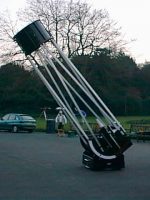
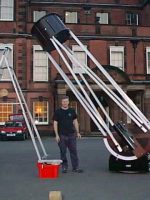
in the Robertson 16 inch Reflector, it is usually a simple matter to lower the telescopes altitude by 4 degrees, using a digital level attached to the telescope. Of course, if Delphinus is a long way from due south, the difference in azimuth between these two objects will start to become much more significant. In a small telescope you may only see a fuzzy blob that is very hard to resolve into stars. However, objects such as this are one of the main reasons why our telescope making group are not satisfied with “small telescopes” – such as the 16 inch at Pex Hill. We have already built two 30 inch telescopes and are currently building three 20 inch telescopes.
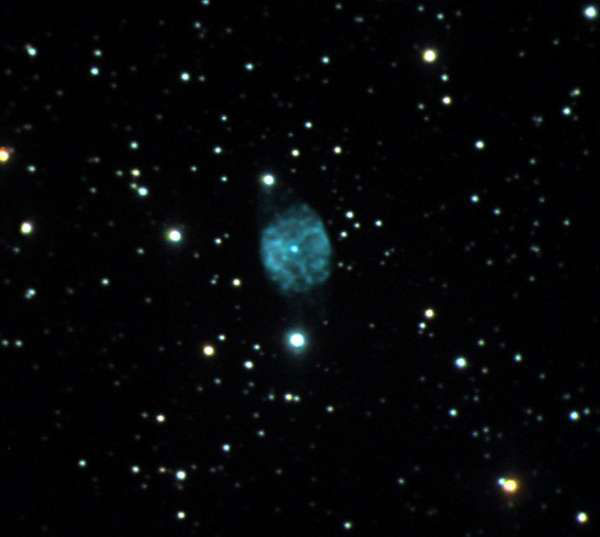
NGC 6905 (The Blue Flash Nebula)

NGC 6905 (The Blue Flash Nebula)

Surprise at the Science Museum, Chris Banks

During a recent trip to London, I paid a visit to the Science Museum. In the space gallery were the old favourites of the mock-up Lunar Module and various rockets and space vehicles. The one item
that really caught my eye however, was the first mirror that Willaim Herschel made for his great 40-foot telescope in 1785. This is a 36-inch mirror and is cast from Speculum metal. For nearly 60 years this was the largest telescope mirror in the World!

William Herschel's 36" Speculum mirror at the Science Museum, London, in 2008

William Herschel’s 36″ Speculum mirror at the Science Museum, London, in 2008

Despite weighing half a ton the mirror was actually too thin and so Herschel decided to make a second, thicker mirror in 1789. In spite of its problems, this original mirror was often used whilst the new main mirror underwent repolishing. Using the 40-foot telescope, Herschel discovered two new moons of Saturn, Enceladus and Mimas.

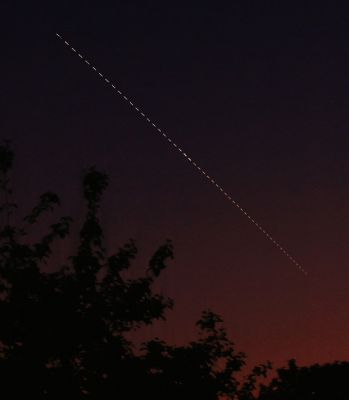
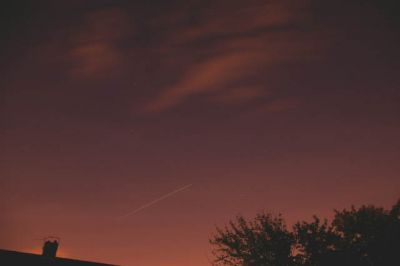
Shuttle and ISS images from June 2007

The International Space Station (ISS) taken by Chris Banks, exact date unknown but early - mid June 2007

The International Space Station (ISS) taken by Chris Banks, exact date unknown but early – mid June 2007

STS-117 taken by Rob Johnson on 9th June 2007 - One with the Canon from 9th, STS-117 before docking. Probably shows a slight flare at the centre of the track?

One with the Canon from 9th, STS-117 before docking.
Probably shows a slight flare at the centre of the track?

Space Shuttle STS-117 taken by Jim Stacey at 23:47 (timezone not known) on 12th June 2007 using: Pentax IST DL2 - f8, 34.1s - 400ASA 18mm lens

Space Shuttle STS-117 taken by Jim Stacey at 23:47 (timezone not known) on 12th June 2007 using:
Pentax IST DL2 – f8,
34.1s – 400ASA 18mm lens

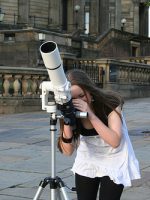
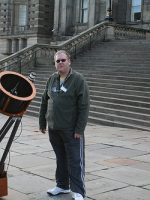
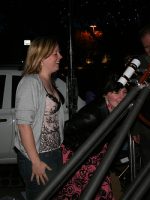
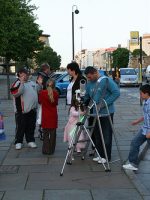
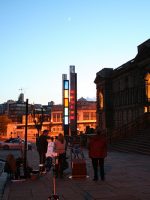
Images from the William Brown Street Sidewalk Astronomy event, 19th May 2007

Images by Dave Thomson, December 2006

Event Report: Sidewalk Astronomy Event, Leasowe Lighthouse, Friday 30th January 2004

Astronomy Evening at Leasowe Lighthouse, Morton
Friday 30th January 2004, 7.30pm – 9.30pm
Event report by Dave Owen

I arrived with Geoff Regan at about 19:00. About 10 minutes later, Graham and Pam Roberts arrived. Graham soon got busy selling LAS booklets and dispensing lots of information to the queue of visitors that soon formed in the doorway.

The inside of the lighthouse is very cramped and soon filled up with people waiting for the slide show to start. Geoff eventually did 3 slide shows of about 15 minutes, punctuated by intervals of about 10 minutes to allow people to circulate round and, hopefully, free up space for other people to escape the cold damp and drizzly weather outside. I did a final slide show to round off the evening.

Steve Southern was able to assist Graham by setting up his laptop PC to display astronomical pictures to the people who were queueing by the doorway. Very late in the evening there was a very brief glimpse of the Moon, but otherwise the weather was far too cloudy to even consider setting up our telescopes. Jim Stacey had brought along his 5 inch Maksutov and I had brought my 80mm f5 refractor. Neither was seen in action but Jim was able to snap a few photos that are shown below.

As in our past 5 annual visits, the Friends of Leasowe Lighthouse were able to supply hot tea, coffee and cakes to our large crowd of visitors, about 70 we reckon. Not too bad for a very cloudy night.

Hopefully, our next trip to these parts (Wirral Country Park on Fri/Sat 27/28 Feb 2004) will be blessed with better weather.

Graham Roberts selling LAS booklets at the Leasowe Lighthouse Sidewalk Astronomy Event, Friday 30th January 2004

Graham Roberts selling LAS booklets

Geoff Regan presenting a slideshow at the Leasowe Lighthouse Sidewalk Astronomy Event, Friday 30th January 2004

Geoff Regan presenting a slideshow

Another image of Geoff Regan presenting a slideshow at the Leasowe Lighthouse Sidewalk Astronomy Event, Friday 30th January 2004


About Young Astronomers’ Days

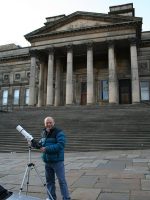
Dave Owen with a telescope at the first Young Astronomers' Day, held at Liverpool Museum in March 1988

The First Young Astronomers Day, held at Liverpool Museum in March 1988

Liverpool Astronomical Society have staged Young Astronomer Days or YADs since March 1988.

The meetings are aimed at children aged 8 to 17 years old who would like to known more about the Universe around them. YAD’s are held at the Liverpool Astronomical Society Pex Hill Observatory, Cronton or other venues several times a year.

The YAD’s are held during day & evening between 2-7pm and have a main theme, such as The Sun, inner planets, outer planets, galaxies and spaceflight, etc. on which events are staged.

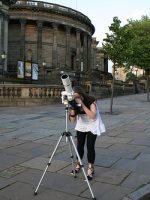
The above images show the first YAD held at Liverpool Museum – March 1988,

LAS Council Members for Session 2012 – 2013

PATRON:

Mr F. S. Hughes

COUNCIL OFFICERS
2012 – 2013

PRESIDENT

Mr Ken Clark

VICE-PRESIDENTS

Mr Rob Johnson
Mr David Galvin

HONORARY VICE-PRESIDENTS

Mr Eric Jones
Mr Murad Ghorbal

HONORARY SECRETARY

Mr Gerard Gilligan

HONORARY TREASURER

Mr Chris Banks

DIRECTOR OF OBSERVATORIES and CURATOR OF INSTRUMENTS.

Mr Brendan Martin

HON.LIBRARIAN.

Mr J.Knott.

ORDINARY COUNCIL MEMBERS

Mrs Patricia Banks
Mr Colin Murray
Mrs Camelia Usher Galvin
Mr David Bentley
Mr David Forshaw

JUNIOR REPRESENTATIVES

Mr Geoff Regan
Mr Steve Southern

HONORARY AUDITOR

Mr H.V.Tracy Forster B.A. (Hons)