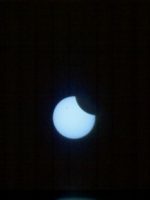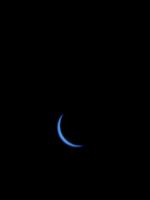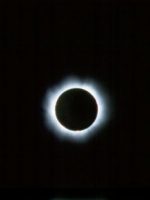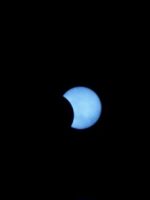
Solar Eclipse 11th August 1999 Report: Elaine Corry (Turkey)

Eclipse From Turkey

As Viewed by A Non-Astronomer

Elaine Corry

Eclipse day dawned bright and early as we went to breakfast at 0500 hours accompanied by the broadcast chant of the muezzin calling the faithful to prayer. Remembering to pick up our lunchboxes (more about them later) we excitedly piled aboard our coaches at 6 o’clock for the four-hour journey to the eclipse site. There had been worries that there might be thunderstorms over the chosen site so we were starting off an hour earlier than planned to allow time for a diversion to an alternative location if necessary – I wouldn’t like to be the person who has to make that decision! As all nine coaches were to travel in convoy we met up at the hotel up the road where we had to wait for the late arrival of Explorer Tours bigwig Brian McGee who had obviously been sweating over the latest weather predictions. Among the other coaches were scattered the other members of the society who we knew were in Turkey with Explorers Tours – Ron Kelley, John Quirk and his wife,the Ghorbals and the Forshaws.

On route the build up of excitement on our coach was tangible. We spent the journey going over the sequence of events, most especially for those members of the party who were to experience their first total eclipse. Some people were literally ‘along for the ride’ and had no idea what to look for so this proved to be very useful. We had taken along the Society’s Solar Eclipse booklet which was in great demand, and Eric Jones had supplied us with local circumstances for smooth limb contacts which we used to draw a plan showing everyone where to look for First Contact, Baily’s Beads and the Diamond Ring. We also talked about when to look for the moon shadow and shadow bands and emphasised the safety aspect as we had several children in the party. All this discussion served to heighten the excitement and anticipation. When the convoy of coaches were stopped outside the Sivas University campus we only discovered later that the police had been trying to persuade the organisers to enter the campus to view the eclipse for our safety in case of a kidnap attempt!

The site Explorers Tours had chosen for viewing the eclipse was 22km east of Sivas near the small village of Guydun on the centre line of the eclipse track. When the coaches trundled down the small road and drew up at the site we saw a wide flat open expanse with the Tecar Daglari hills in the distance. There was an Army jeep full of soldiers and village representatives standing by and we were told that the army had dug us a latrine – one for all 400 of us! There was also a tanker of water for ablutions and enterprising villagers were selling beer and water.

After leaving the coaches everyone dispersed to find their own ideal spot. We had palled up with Terry and Kevin and we all decided our first priority was to find a spot to investigate our packed lunches. They proved very interesting if somewhat unappetising – a whole baked potato (no butter), a whole 6inch long cucumber (no knife to peel it- thank goodness for my little penknife), a dry roll with a slice of cheese, a huge hunk of dry cake and a carton of sour cherry drink. Lunch didn’t take long! (However the boxes came into their own later as you will see).

By this time Terry and I decided we would brave the queue for the toilet. It proved to be a very sociable gathering with much hilarity which was increased when the local television crew, which had been following the tour around and reporting on the news each night, decided that the queue was a worthy subject. I never got to know whether it went out on local television which was probably just as well. That wasn’t as bad as the fate of one poor member of our coach party. She lost her sandal down the pit! It was now time to establish our ‘spec’. A fair number of people had decided to set up their equipment on a small rise and as we felt that would be a good vantagepoint especially for looking out for the approaching and receding shadow we opted to follow suit. We found Ron, the Ghorbals and Forshaws up there too so nearly all the Liverpool contingent were together. I started taking photos of groups then, horror – the camera jammed. I was at the end of a roll and I just thought it was finished and rewound so opened the back to realise that it hadn’t rewound so I ended up losing all the pictures I had taken that day plus some from the previous afternoon. I thought that was it but luckily Terry realised I had a manual rewind which seemed to solve the problem as the next film I put in was OK – thank goodness.

Telescopes were massed along the rise and we were getting really excited. Murad was using his telescope for projecting the sun’s image before first contact and we could clearly see several large sunspots in the bottom right hand quadrant, which gave us an indication of where prominences might appear. First contact was due at 1307 local time and was apparently spot on although it was a few seconds later before I was able to detect that first small bite out of the edge of the sun. As the partial phase progressed the projections began in earnest as we strived to outdo each other with novel ideas. Those using telescopes and binoculars produced clear crisp images but fun versions were produced using the holes in Ron’s hat, a straw hat, a pinhole in card and the piece de resistance – my flat cheese grater. Win didn’t really believe that I meant to take a cheese grater but it proved to be of great (sorry – couldn’t resist it) interest as it acted as a pseudo tree projecting multiple crescent shaped images of the sun. (A large party had commandeered the one tree in the area as soon as we arrived).

Solar Eclipse 11th August 1999 - Win and Elaine Corry's Cheese Grater solar projector (after First Contact)

Solar Eclipse 11th August 1999 – Win and Elaine Corry’s Cheese Grater solar projector (after First Contact)

Solar Eclipse 11th August 1999 - Elaine Corry with the Cheese Grater solar projector (after Third Contact)

Elaine with the Cheese Grater solar projector (after Third Contact)

The local villagers were very interested and joined in and one man, in fun, made a circle with his fingers and laughingly lined it up to project. This gave Ron the idea to make animal face shadows with the eye being a projection of the sun. Remember the lunch boxes? Now is when they proved most useful as Murad’s wife had the idea of using one for pinhole projection. This was very successful, as the box was about 15 inches long and 5 inches square in section.

Thus we usefully filled our time waiting for the moment of second contact. As the eclipse progressed we started glancing more often at the crescent sun through our special eclipse glasses. The light was changing very subtly at first but suddenly Terry said that we didn’t need our sunglasses any more or the long-sleeved cover-ups we had to protect us from burning under the searing heat. There was 1hr 24 minutes between first and second contacts and I reckon we must have been an hour into that before there was an appreciable drop in either light or heat levels. It was now that, as the light dropped, we could clearly see Venus but try as I might I couldn’t see Mercury. As totality neared we became aware of a change in colour values. The grass became bluer and the red tinged soil greyer. It was as though I suddenly realised that I was really there and was really going to experience my first total eclipse and I felt very emotional as though I was going to burst into tears. I was not alone – I could see that Terry, Kevin and Win were full up too. I was jumping about with excitement when suddenly the pinnacle of my hopes for the eclipse was achieved – I saw shadow bands. A group of Americans nearby had laid out a white sheet, and there, very clearly, and seemingly for several minutes, we were able to observe the rapidly flickering waves of light. It was long enough to call Win over from lower down the rise and hopefully all the other society members there saw them too. I felt very privileged especially when I later heard Patrick Moore say on ‘The Sky at Night’ that he has never seen them.

Now came the last dramatic drop in light level as second contact neared. I missed the final Baily’s bead as I had decided to try to see the approaching wall of shadow. People were calling out saying what to look for next but you can’t do everything on your first eclipse and I wanted just to absorb as much as possible of the atmosphere. I didn’t manage to see the shadow but then followed the quickest two minutes of my life. I was overawed and just gazed at that black disc surrounded by a magnificent corona, which to my eyes seemed to extend at least the distance of the radius.

There were several superb glowing red prominences; the one which I noticed most was at 3 o’clock. Again I was aware, even in my absorption, of people calling out in amazement at the prominences and the size of the corona, and also of the constant click of camera shutters. I completely forgot to look for any stars or for Mercury! The sky was dark blue and all around over the hills the horizon was glowing. Win had our binoculars and I was suddenly aware of Ron thrusting his binoculars into my hands for which I was very grateful. It was cool and eerie and you could understand why primitive people would feel that it was the end of the world, as indeed it would be if our sun ever failed to re-emerge from behind the moon. All too soon the dazzling brilliance of a magnificent diamond ring signified third contact and we had to look away. We looked over the plain and saw the receding wall of shadow travelling rapidly across the valley and up over the hills on the other side. The increase in light value was immediate and it was warm again – a return to normality after the experience of a lifetime. Everyone was on a high, full of euphoria and chattering, exchanging feelings, and checking what each other had seen; trying to fix the moment in our minds for all time.

For myself I don’t think there is any danger I will forget any of that day. For a while we remained doing a few more projections but it was amazing how quickly the sun was uncovered and gradually the encampment broke up as everyone returned to the coaches. It was then that, from all around us, young soldiers appeared. They had been dug in around the site guarding us most unobtrusively. Back at the coach we had a celebration beer and then at 1520hrs, when the sun was almost uncovered, a happy but weary band of travellers left the site waving to the local villagers who probably thought we were all a bit mad travelling all that way for 2 minutes. Not me – I’d do it again tomorrow.

Gerard Gilligan’s Total Solar Eclipse 1999 Observations

Eclipse 1999 Observations by Gerard Gilligan
From Altmunster, Salzkammergut Region, Austria

Total Success! John Knott & Gerard Gilligan at Altmunster, Salzkammergut Region, Austria for the Total Solar Eclipse, August 1999

Total Success!
John Knott & Gerard Gilligan


Total Solar Eclipse, August 1999 at 09:30 UT, taken by Gerard Gilligan from Altmunster, Salzkammergut Region, Austria, using Pentax K 1000 SLR Camera, fitted with 500mm f8 Canton Lens. Film used was Kodak Elite, 400 ASA slide film.

09:30 UT

Total Solar Eclipse, August 1999 at 09:38 UT, taken by Gerard Gilligan from Altmunster, Salzkammergut Region, Austria, using Pentax K 1000 SLR Camera, fitted with 500mm f8 Canton Lens. Film used was Kodak Elite, 400 ASA slide film.

09:38 UT

Total Solar Eclipse, August 1999 at 10:13 UT, taken by Gerard Gilligan from Altmunster, Salzkammergut Region, Austria, using Pentax K 1000 SLR Camera, fitted with 500mm f8 Canton Lens. Film used was Kodak Elite, 400 ASA slide film.

10:13 UT

Total Solar Eclipse, August 1999 at 10:30 UT, taken by Gerard Gilligan from Altmunster, Salzkammergut Region, Austria, using Pentax K 1000 SLR Camera, fitted with 500mm f8 Canton Lens. Film used was Kodak Elite, 400 ASA slide film.

10:30 UT

Total Solar Eclipse, August 1999 at 10:34 UT, taken by Gerard Gilligan from Altmunster, Salzkammergut Region, Austria, using Pentax K 1000 SLR Camera, fitted with 500mm f8 Canton Lens. Film used was Kodak Elite, 400 ASA slide film.

10:34 UT

Total Solar Eclipse, August 1999 at 10:38 UT, taken by Gerard Gilligan from Altmunster, Salzkammergut Region, Austria, using Pentax K 1000 SLR Camera, fitted with 500mm f8 Canton Lens. Film used was Kodak Elite, 400 ASA slide film.

10:38 UT

Total Solar Eclipse, August 1999 at 10:41 UT, taken by Gerard Gilligan from Altmunster, Salzkammergut Region, Austria, using Pentax K 1000 SLR Camera, fitted with 500mm f8 Canton Lens. 1/1000th second. Film used was Kodak Elite, 400 ASA slide film.

10:41 UT,  1/1000th second

Total Solar Eclipse, August 1999 at 10:41 UT, taken by Gerard Gilligan from Altmunster, Salzkammergut Region, Austria, using Pentax K 1000 SLR Camera, fitted with 500mm f8 Canton Lens. 1/500th second. Film used was Kodak Elite, 400 ASA slide film.

10:41 UT,  1/500th second

Total Solar Eclipse, August 1999 at 10:41 UT, taken by Gerard Gilligan from Altmunster, Salzkammergut Region, Austria, using Pentax K 1000 SLR Camera, fitted with 500mm f8 Canton Lens. 1/250th second. Film used was Kodak Elite, 400 ASA slide film.

10:41 UT,  1/250th second

Total Solar Eclipse, August 1999 at 10:41 UT, taken by Gerard Gilligan from Altmunster, Salzkammergut Region, Austria, using Pentax K 1000 SLR Camera, fitted with 500mm f8 Canton Lens. 1/125th second. Film used was Kodak Elite, 400 ASA slide film.

10:41 UT, 1/125th second

Total Solar Eclipse, August 1999 at 11:00 UT, taken by Gerard Gilligan from Altmunster, Salzkammergut Region, Austria, using Pentax K 1000 SLR Camera, fitted with 500mm f8 Canton Lens. Film used was Kodak Elite, 400 ASA slide film.

11:00 UT

Total Solar Eclipse, August 1999 at 11:13 UT, taken by Gerard Gilligan from Altmunster, Salzkammergut Region, Austria, using Pentax K 1000 SLR Camera, fitted with 500mm f8 Canton Lens. Film used was Kodak Elite, 400 ASA slide film.

11:13 UT

Total Solar Eclipse, August 1999 at 11:40 UT, taken by Gerard Gilligan from Altmunster, Salzkammergut Region, Austria, using Pentax K 1000 SLR Camera, fitted with 500mm f8 Canton Lens. Film used was Kodak Elite, 400 ASA slide film.

11:40 UT

Total Solar Eclipse, August 1999 at 11:50 UT, taken by Gerard Gilligan from Altmunster, Salzkammergut Region, Austria, using Pentax K 1000 SLR Camera, fitted with 500mm f8 Canton Lens. Film used was Kodak Elite, 400 ASA slide film.

11:50 UT

Total Solar Eclipse, August 1999 at 12:00 UT, taken by Gerard Gilligan from Altmunster, Salzkammergut Region, Austria, using Pentax K 1000 SLR Camera, fitted with 500mm f8 Canton Lens. Film used was Kodak Elite, 400 ASA slide film.

12:00 UT

Total Solar Eclipse, August 1999 at 12:02 UT, taken by Gerard Gilligan from Altmunster, Salzkammergut Region, Austria, using Pentax K 1000 SLR Camera, fitted with 500mm f8 Canton Lens. Film used was Kodak Elite, 400 ASA slide film.

12:02 UT


All Images taken with Pentax K 1000 SLR Camera, fitted with 500mm f8 Canton Lens.
Partial phases taken using Mylar filter. Film used was Kodak Elite, 400 ASA slide film.

All Images are © Gerard Gilligan
With Thanks to Tony Williams

Pex Hill Observatory: 1994 – 1999

Large LAS colour logo on white background, circa 1999

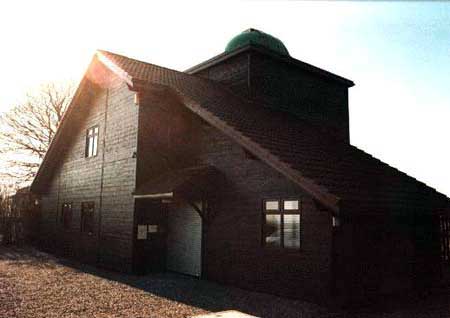
The Leighton Observatory at Pex Hill, Cronton

Pex Hill Observatory & Visitor Centre

Dr. Patrick Moore C.B.E. officially opens the Observatory at Pex Hill, Sunday 20th March 1994

Dr. Patrick Moore C.B.E. officially opens the Observatory at Pex Hill, Sunday 20th March 1994

Knowsley Countryside Ranger Service (KCB Parks) logo, circa 1999

Operated in conjunction with the Knowsley Countryside Ranger Service

Liverpool Astronomical Society logo (colour, pre-gradient, c.1999)

Liverpool Astronomical Society
Over 100 Years of Astronomy on Merseyside

North West Water logo, circa 1999

With thanks to North West Water plc.

The Liverpool Astronomical Society Observatory Pex Hill, Cronton, Knowsley

The First Five Years 1994 ~ 1999

The Observatory project came about following the generous donation of a large telescope to the Society by the then Patron the late Mr J.R.Platt. The Society quickly began the tesk of raising money for the project and initiated a search for a suitable site. As a response to the project the Society instigated its series of Croxteth Hall & Park Public Star Party Weekends.

The return of Comet Halley in 1985-86 provided a golden opportunity both to promote astronomy and raise funds for the proposed observatory.

An appeal to the membership and other fund raising events soon boosted the observatory account.

The 16" Robertson Newtonian Reflecting Telescope, at Pex Hill

The 16″ Robertson Newtonian Reflecting Telescope, at Pex Hill

Many problems and delays were encountered in finding a suitable site, until the present site was obtained. On hearing the news of the opening of the observatory, a suitable dome was ordered and thoughts once again turned to raising sufficient funds to operate the telescope in its first year. The Observatory at Pex Hill now houses a large 16inch Newtonian reflecting telescope, which was a gift to the Society by Mr A.Robertson of the Isle of Man.

The telescope had been in storage for some years and has undergone a partial restoration, including mirror recoating, with the help of what was Scope City, prior to its installation. An Appeal to the membership and a generous donation from The Ford of Britain Trust has ensured that the telescope will be extremely well equipped for visual work. The Society’s publications and the Newsletter have raised a considerable sum towards the cost of the dome and equipping the Observatory. For the next five years, restoration of the dome and improvements to the telescope mount are underway, and a recent upgrade to the observatory computer has been made, with the view to perhaps install a telescope robotic system at a later date

Soon however the plan is to replace the 16-inch as the main observatory telescope with a 10-inch or 12-inch Meade LX2000.Testing will be carried out with a CCD camera and a members Meade 8-inch telescope on the new pillar extension which was recently fitted to the observatory by members David Galvin and Steve Southern.

The opening of the observatory brings about new opportunities for the Society, but its aims remain the same as they were when the Liverpool Astronomical Society was formed in 1881:-

“To promote the science of Astronomy primarily in  Liverpool and the area thereof.”

OPEN DAY AT THE OBSERVATORY
Held on Saturday MARCH 20th 1999

Old route map for Pex Hill

Directions to the Pex Hill Observatory

The Observatory is managed by Liverpool Astronomical Society in conjunction with Knowsley Countryside Ranger Service and North West Water PLC. The Observatory is for use by Society members only, however, should you wish to book any individual or group visits to the observatory then please contact:-

The Director of the Liverpool A.S. Observatories
(Contact details removed as no longer valid)
For More information regarding the Pex Hill Visitor Centre, public events, school/group bookings for guided walks and events in the environmental classroom, please contact: (Contact details removed as no longer valid)

Society News and Night Sky Notes – August 1999

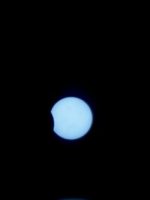
A Total Solar Eclipse, showing the Corona (date and location of eclipse unknown)

Society News Headlines

  • August 2nd – Alpha Capricornids meteor shower Max.
  • August 3rd – Comet Arend at perihelion, (1.917AU).
  • August 4th – Jupiter 4° North of Moon.
  • August 5th – Saturn 3° North of Moon.
  • August 5th – Mercury stationary.
  • August 6th – Aldebaran 0.8° South of Moon.
  • August 6th – Delta & Iota Aquarids meteor shower maximum.
  • August 6th – Public Open Night at LAS Pex Hill Observatory.
  • August 7th – Uranus at opposition and at its best.
  • August 8th – RAS National Astronomy Meeting on Channel Islands.
  • August 8th – BAA Total Eclipse Meeting, at Truro School, Cornwall. (ends August 14th).
  • August 10th – Mercury 1.2° South of Moon.
  • August 10th – Venus 8° South of Regulus.
  • August 11th – Total Solar Eclipse, seen from S.W. England, Europe.
  • August 11th – 92% Partial Solar Eclipse from Liverpool. Mid Eclipse at 11h:16m:53s.
  • August 13th – Perseids meteor shower maximum, Excellent prospects.
  • August 14th – 2nd International Workshop on Cometary Astronomy, Cambridge, England. (ends Aug 16th).
  • August 14th – Mercury at Greatest elongation from Sun, 19°.
  • August 17th – Comet C/1999 H3 (Linear) at perihelion (3.502AU).
  • August 18th – Mars 7° South of Moon.
  • August 20th – Venus at Inferior conjunction.
  • August 21st – Pluto stationary.
  • August 24th – Neptune 0.7° South of Moon.
  • August 25th – Comet Giclas at Perihelion. (1.846AU).
  • August 25th – Jupiter is stationary.
  • August 25th – Uranus 0.6° South of Moon.
  • August 26th – Mercury 10° North of Moon.
  • August 30th – Saturn stationary.
  • August 31st – Jupiter is 4° North of Moon.

THE NIGHT SKY DURING THE MONTH OF AUGUST 1999

Will it be cloudy to-night?, ask the The U.K. Goverment Met Office Weather service. To make your own star chart fo your location at any time, Click Here.


The Sun and Moon


All times are in BRITISH SUMMER TIME (BST). Times For Observer in Liverpool, Merseyside, England, U.K.
Latitude 53 degs 24 mins North.
Longitude +3.0 degs West.


            4th          9th         14th       19th       24th        29th         
SUNRISE    05:32        05:41       05:49      05:58      06:07       06:16         
SUNSET     21:03        20:53       20:43      20:32      20:21       20:09
PHASES OF THE MOON DURING AUGUST 1999
FULL MOON
on 26th
at 00h:49m
LAST QUARTER
on 4th
at 18h:28m
NEW MOON
on 11th
at 12h:10m
FIRST QUARTER
on 19th
at 01h:48m


August 1999 Eclipse


THE PLANETS THIS MONTH.


MERCURY.

On the 9th Mercury starts is second morning apparition of 1999, this table shows its positions throughout the apparition.

Morning apparition of Mercury during August 1999

Morning apparition of Mercury during August 1999


VENUS.

Venus quickly rises above the Eastern horizon in the pre-dawn sky by the end of the month having passes its inferior conjunction on the 20th. It will soon become very prominent as it passes through Leo, gaining brightness as the phase changes from crescent towards full phase.


MARS.

Mars sinks into the evening twilight setting at around 22h:00m at the end of the Month.On the 18th Mars 6° South of the Moon. On the 8th binoculars and telescopes will show that Mars has a temporary companion as the starAlpha Librae lies close by.

MARSWATCH – latest observations of the red planet.


ASTEROIDS.

  • 16 Psyche at Mag 9.4 can be found within the stars of Aquarius & Capricornus during August.

For More information on Asteroids Click Here.


JUPITER.

Jupiter can be found in the South West by midnight. Its apparent diameter increases from 41 ” to 46″ as the month progresses.

Launched in October 1989, the Galileo Jupiter Probe entered orbit around the great planet on December 7th 1995. The Project Galileo Homepage will give you up-to-date information and the very latest images returned.


SATURN.

Saturn remains purely a morning object with the crescent Moon lying close by on the 5th.


URANUS and NEPTUNE.

Uranus reaches opposition on the 7th and is therefore at its best for picking up with binoculars or low power telescope. Neptune is also well placed. Don’t expect to see a disk though as Uranus appears only 4 ” across and Neptune a paltry 2″ across. Compare these sizes with Jupiter and you will see the difficulty in observing these two planets.

Uranus Positions for the 1st August:

                          R.A.                   DEC                    TRANSIT TIME           MAG
                      21h:11m:04s           -16°:59':19"                   01h:46m             5.7

Neptune Positions for the 1st August: 

                          R.A.                   DEC                    TRANSIT TIME           MAG
                      20h:20m:10s           -19°:15':17"                   00h:52m             7.9

PLUTO.

Pluto can be found on the border of Ophiuchus , above and to the right of the mag 2.6 star Zeta Ophiuchi. The best time to look for the planet is around New Moon. The dates below will be a guide for planning observations.

Positions for August are when pluto's elongation angle is greater than 90°.
    DATE                      R.A.                   DEC                   TRANSIT TIME
    Aug 9th                16h:28m:45s            -10°:07':00"                 20h:32m
    Aug 19th               16h:28m:35s            -10°:11':18"                 19h:53m

METEORS.

  • 2nd August Alpha Capricornids 8 per hour Unfavourable. 19 day old Moon.
  • 6th August Iota Aquarids 8 per hour Fairly Favourable. 23 day old Moon.
  • 7th August Delta Aquarids 10 per hour Fairly Favourable. 24 day old Moon.
  • 12/13th August Perseids 75 per hour Very Favourable. 1 day old Moon.favourable.
  • 28th August Alpha Aurigids 10 per hour Unfavourable. 16 day old Moon.

COMETS.

  • Comet Arend at Perihelion on August 3rd. (1.917AU)
  • Comet C/1999 H3 (Linear) at Perihelion on August 17th. (3.502AU)
  • Comet Giclas at Perihelion on August 25th. (1.846AU)

Plus these pages will give daily and weekly reports of this and other Comets progress.


OCCULTATIONS.

  • August 27th at 00h:32m Reappearance of Psi Aquarii Mag 4.5

Information Index – The Total Solar Eclipse of August 11th 1999.

A Total Solar Eclipse, showing the Corona (date and location of eclipse unknown)

May We Wish Your All Clear, “Dark” Skies For August 11th 1999!
(May The Shadow Of The Moon Be With You.)

PLEASE NOTE FOR YOUR OWN SAFETY AND WELL BEING:
Do Not Attempt To Observe The Partial Or Annular Phases Of Eclipse With The Naked Eye.
Failure To Use Appropriate Filtration May Result In Permanent Eye Damage Or Even Blindness!!

Please See Fred Espenak’s Safety Page.
Eye Safety And Solar Eclipses.


NASA RP 1398:TOTAL SOLAR ECLIPSE of 1999 AUGUST 11th


Your Eclipse Questions???


The Eclipse From The U.K.


The Eclipse From Europe & General Information sites.

Partial Solar Eclipse – Visible from Liverpool on August 11th, 1999

August 11th sees the last total solar eclipse visible from the U.K. for over 90 years. From Liverpool it is a very large partial eclipse but you only have to travel a few hundred miles to Cornwall or Devon to observe the rare phonomena of totality. From Liverpool the partial eclipse starts at 10:02:44 BST with the Sun high up in the South East. Maximum eclipse, when 92% of the Sun’s disk is covered by the Moon, occurs at 11:16:53 BST and the eclipse ends at 12:34:56 BST with the Sun almost due South.


EXTREME CAUTION

Observers are reminded to use extreme caution when viewing the Sun. Never look at the Sun directly either through optical instruments or the naked eye, without adequate filtration. Heavily exposed X-Ray film and arc welding goggles, (not the gas welding type) are acceptable forms of filter. But do not use them at the telescope. View the event in complete safety by protecting the Sun’s image on to a piece of white matte card. The simplest method of projection is to use two sheets of card.Make a pinhole in one of the cards and project the image of the Sun on to the other card. By varying the distance between the cards the image can be larger or small.


Other Ways of Seeing this Eclipse in Safety.

  • Indoors you can crate a larger version of this pinhole camera by drawing the curtains to leave just a small gap. Near the maximum of the eclipse the image of the crescent should be projected on to a wall or the floor. The cord holes of a set of ventian blinds can produce a stack of overlapping crescents.
  • Out of doors, the gaps between the leaves of trees can also act as many pinhole cameras producing overlapping crescents on the ground.
  • With am eclipse of this magnitude you may just detect near maximum a slight difference in the quality of the light and the colour of the sky.

Times for the Partial Solar Eclipse – August 11th 1999.

Info sheet: August 1999 Solar Eclipse (partial from Liverpool, UK) Times (BST) and Other Information is Calculated for Liverpool, Merseyside, U.K. Position of Latitude 53.4 degs North and Longitude 3 degs West.

Info sheet: August 1999 Solar Eclipse (partial from Liverpool, UK)
Times (BST) and Other Information is Calculated for Liverpool, Merseyside, U.K.
Position of Latitude 53.4 degs North and Longitude 3 degs West.

Partial Solar Eclipse from Liverpool – 1999 August 11th
EVENT TIME (BST) P.A. Mag Alt° Az°
FIRST CONTACT 10h:02m:43.8s 277° * 44° 132°
MAXIMUM ECLIPSE 11h:16m:53.1s * 0.920 50° 157°
LAST CONTACT 12h:34m:56.0s 110° * 52° 187°

P.A. = Position Angle is measured from North anticlockwise on the Sun’s disk.
V.A. = Vertex Angle is measured from the top of the Sun also anticlockwise on the Sun’s disk.

The difference between P.A. and V.A. is due to the SUN’s low altitude. If the Sun were to lie due South, (and therefore with its North point vertical) the two values would be similar.


Return to the August 1999 News & Sky Notes Page

Society News and Night Sky Notes – July 1999

Society News Headlines

  • July 1st – Neptune 0.6° South of Moon.
  • July 2nd – Uranus 0.4° South of Moon.
  • July 6th – Earth at Aphelion at 23h:00m.(1.016719 AU).
  • July 7th – Jupiter 4° North of Moon.
  • July 8th – Saturn 3° North of Moon.
  • July 10th – Aldebaran 0.8° South of Moon.
  • July 10th – Lunar Occultation of Aldebaran (link removed as URL is invalid) from Liverpool. Disappearance at 09:15:51 (Bright Daylight).
  • July 11th – Only one month to go too the BIG EVENT!.
  • July 11th – Comet C/1999H1 (Lee) at Perihelion (0.709AU).
  • July 11th – 20th Anniversary (1979) Skylab re-enters into Earth’s Atmosphere.
  • July 12th – Mercury Stationary.
  • July 13th – Venus 1.5° South of Regulus.
  • July 14th – Mercury 3° South of Moon.
  • July 14th – Venus at Greatest brlliancy.
  • July 15th – Regulus 1.1° South of Moon.
  • July 15th – Venus 3° South of Moon.
  • July 16th – 30th Anniversary (1969) of the launch of Apollo 11.
  • July 20th – Mars 7° South of Moon.
  • July 20th – 30th Anniversary (1969) of the Apollo 11 Moonlanding.
  • July 20th – STS-93 launch, space shuttle Columbia, Payload- Chandra X-Ray Observatory.(AXAF)
  • July 24th – Comet C/1999 K6 (LINEAR) at Perihelion (2.251AU).
  • July 24th – Ceres: conjunction with Sun.
  • July 25th – Juno stationary.
  • July 26th – Neptune at opposition.
  • July 26th – Mercury: Inferior conjunction.
  • July 27th – Venus stationary.
  • July 28th – Partial Lunar Eclipse (link removed as URL is invalid), (Not seen from UK).
  • July 28th – Special LAS summer Lecture – “Chasing the Moon’s Shadow” (link removed as URL is invalid), Liverpool University at 7pm.
  • July 28th – Neptune 0.6° South of Moon.
  • July 29th – Uranus 0.5° South of Moon.
  • July 31st – Lunar Prospector spacecraft to crash on Moon to-day.

THE NIGHT SKY DURING THE MONTH OF JULY 1999

Will it be cloudy to-night?, ask the The U.K. Goverment Met Office Weather service. To make your own star chart fo your location at any time, Click Here.


The Sun and Moon


All times are in BRITISH SUMMER TIME (BST). Times For Observer in Liverpool, Merseyside, England, U.K.
Latitude 53 degs 24 mins North.
Longitude +3.0 degs West.


           June 30th    July 5th    10th       15th       20th        25th          30th
SUNRISE    04:47        05:51       04:56      05:02      05:09       05:16         05:24
SUNSET     21:44        21:42       21:38      21:33      21:27       21:20         21:12
PHASES OF THE MOON DURING JULY 1999
FIRST QUARTER
on 20th
at 19h:14m
FULL MOON
on 28th
at 12h:26m
LAST QUARTER
on 6th
at 12h:58m
NEW MOON
on 13th
at 03h:25m

THE PLANETS THIS MONTH.


MERCURY.

Mercury is at inferior conjunction on the 26th and is unobservable.


VENUS.

Venus, which has been so bright and obvious during the first half of the year in the Western evening sky, heads straight down towards the horizon for an August inferior conjunction. Venus’ apparent size in the middle of the month is 30″ abd displays a 30% Sunlit disk.


MARS.

Mars sets in the early hours of the morning and this, coupled with long daylight hours, a small (10″) disk and decreasing brightness makes it a poor telescopic object unless very high powers are used in excellent seeing conditions. For the third time this year Mars encounters the stars Kappa and Lambda Virginis. 4° South of Kappa on the 16th, and 2° North of Lambda on the 22nd. On the 20th Mars lies 6° South of the Moon.

MARSWATCH – latest observations of the red planet.


ASTEROIDS.

  • 63 Ausonia is at opposition on 26th in Capricornus Mag 10
  • 16 Psyche is at opposition next month also in Capricornus at Mag 10.0
  • Juno is well placed this month at Mag 10.

For More information on Asteroids Click Here.


JUPITER.

Jupiter now rises at around midnight in the middle of the month, lying due South at around 07:30. On the 7th at 18h:00m Jupiter is 4°.5 North of the moon. Look for Jupiter and Saturn. Launched in October 1989, the Galileo Jupiter Probe entered orbit around the great planet on December 7th 1995. The Project Galileo Homepage will give you up-to-date information and the very latest images returned.


SATURN.

Saturn can also be found in the pre-dawn South Eastern sky along with Jupiter. Saturn will be the fainter of the two objects.


URANUS and NEPTUNE.

Uranus is at its brightest now and at magnitude 5.7 is just visible to the unaided eye provided you know where to look. With binoculars you should have no problem.

Neptune, like Uranus, lies in the constellation of Capricornus. A five minute exposure of the area using even a 50mm lens will record these two outer planets when the print or slide is compared with a star atlas.

Uranus Positions for the 1st July:

                          R.A.                   DEC                    TRANSIT TIME           MAG
                      21h:15m:26s           -16°:39':15"                   03h:53m             5.7
Neptune Positions for the 1st July:

                          R.A.                   DEC                    TRANSIT TIME           MAG
                      20h:23m:31s           -19°:33':04"                   03h:01m             7.9

PLUTO.

Pluto can be found in Ophiuchus, above and to the right of the mag 2.6 star Zeta Ophiuchi. The best time to look for the planet is around New Moon. The dates below will be a guide for planning observations.

Positions for July are when pluto's elongation angle is greater than 90°.

DATE                      R.A.                   DEC                   TRANSIT TIME
July 10th              16h:33m:15s            -09°:57':19"                 00h:32m
July 20th              16h:32m:13s            -09°:56':54"                 23h:52m
July 30th              16h:31m:14s            -09°:57':17"                 23h:12m

Pluto is best seen between July 6th – 20th.


METEORS.

  • Alpha-Cygnids on July 21st (6 per hour) Fairly Favourable Moon 8 days old.
  • Capricornids on July 8th/15th and 26th Multiple radiant- (6 per hour):
    • 8th – Fairly favourable/MOON 23 days old.
    • 15th – Fairly favourable/MOON 2 days old.
    • 26th – Unfavourable/MOON 13 days old.
  • Delta-Aquarids on July 28th and Aug 7th. Double radiant:
    • (20 per hour on 28th) Unfavourable/MOON 14 days old. (From South)
    • (10 per hour on Aug 7th) Fairly Favourable/MOON 24 days old.(From North – Broad peak)

COMETS.

  • Comet (1999 H1) Lee can be found in the Morning sky at the end of July at Mag 7. Perihelion on July 11th at (0.707AU)
  • Comet 10P/Tempel 2 is brighting, but will only reach 10th Mag.

Plus these pages will give daily and weekly reports of this and other Comets progress.


OCCULTATIONS.

  • July 3rd at 03h:51m Reappearance of lota Aquarii(In a bright sky).
  • July 15th at 22h:22m Disappearance of Alpha leonis – Regulus. (In a bright sky).
  • July 25th at 21h:52m Disappearance of Mu Sagittarii. (In a bright sky).
  • July 26th at 23h:54m Disappearnace of Pi Sagittarii. (In a bright sky).

Society News and Night Sky Notes – June 1999

Society News Headlines

  • June 1st: Look out for Noctilucent Clouds in the North after dark.
  • June 3rd: Neptune 0.7° South of Moon.
  • June 4th: Uranus 0.5° South of Moon.
  • June 5th: Mars Stationary.
  • June 6th: BBC Sky at Night with Patrick Moore. Subject:Solar Photography. Rpt BBC2 June 12th.
  • June 6th: Pex Hill Observatory Public Open Day 1pm – 5pm. (Sunday).
  • June 10th: Jupiter 4° North of Moon.
  • June 10th: First of two maxima dates of Ophiuchids meteor shower.( 2nd Maxima on June 20th). ZHR is 10.
  • June 11th: Saturn 3° North of Moon.
  • June 11th: Venus at greatest elongation from Sun, 45° East.
  • June 11th: Pex Hill Observatory public Open night. 7:30pm – 9:30pm.
  • June 15th: Mercury 4° North of Moon.
  • June 17th: Venus 2° North of Moon.
  • June 18th: William Lassell’s 200th Birthday.
  • June 18th: Regulus 1° South of Moon.
  • June 21st: Summer Solstice at 20h:50m BST.
  • June 21st: Mercury 5° South of Pollux.
  • June 22nd: Mars 6° South of Moon.
  • June 22nd: Comet P/1988 V1 (Ge-Wang) at Perihelion.
  • June 25th: Comet C/1998 T1 (Linear) at Perihelion.
  • June 28th: BAA Exhibition Meeting Starts 12 Noon at The London Guildhall University, Calcutta House.
  • June 28th: Mercury at greatest elongation, 26° East. (Poorly seen from Liverpool).

THE NIGHT SKY DURING THE MONTH OF JUNE 1999

Will it be cloudy to-night?, ask the The U.K. Goverment Met Office Weather service. To make your own star chart fo your location at any time, Click Here.


The Sun and Moon


All times are in BRITISH SUMMER TIME (BST). Times For Observer in Liverpool, Merseyside, England, U.K.
Latitude 53 degs 24 mins North.
Longitude +3.0 degs West.


           May 31st     June 5th     10th       15th       20th        25th          30th
SUNRISE    04:51        04:47       04:44      04:43      04:43       04:44         04:47
SUNSET     21:29        21:34       21:39      21:42      21:44       21:45         21:44

The SUMMER SOLSTICE occurs on the 21st at 19h:50m UT, the longest day of the year, and when the Sun will be at its highest point in the sky this year. The Sun lies in the constellations of Taurus/Gemini. Solstice is latin word literal meaning “Sun standstill”.


PHASES OF THE MOON DURING JUNE 1999
NEW MOON
on 13th
at 19h:04m
FIRST QUARTER
on 20th
at 18h:14mm
FULL MOON
on 28th
at 21h:39m
LAST QUARTER
on 7th
at 04h:21m


THE PLANETS THIS MONTH.


MERCURY.

June sees the second evening apparition of Mercury this year. Because the angle of its orbit with respect to our horizon is shallower than it wa in February, its height above the horizon at the end of civil twilight is lower. So, on the 15th Mercury is only 4.5° above the horizon at an azimuth of just over 300° roughly an hour or so after Sunset. There will be no more favourable evening apparitions this year.


VENUS.

Venus continues its descent into the evening twilight and will soon be lost in the murk even though it is at its maximum distance from the Sun on the 11th. On the 12th an opportunity exits for owners of binoculars and small telescopes as Venus skirts a mere 40′ North of the bright wide open star cluster M44 in Cancer. This cluster is also known as the Beehive and Praesepe. On the 17th at 04h Venus is 3° North of the Moon.


MARS.

Mars stops its retrograde motion this month and heads back Eastwards through Virgo passing 2° North of Alpha Virginis on the 6th for the second time this year. On the 23rd at 01h the Moon passes 5° North of Mars. Januarys’ sky notes described how we were not looking exactly “face-on” to Mars’ Sunlit hemisphere which meant that we were seeing a slightly gibbous phase. As Mars neared opposition this phenomenon disappeared and the phase became full as you would expect of an outer planet. Now, as Mars moves away from its April opposition the gibbous phase starts to show itself on the other side of the disk. The two other things readily apparent are that the apparent diameter is decreasing quite quickly along with its brightness.

MARSWATCH – latest observations of the red planet.


ASTEROIDS.

  • Ceres can be found in Gemini at Mag 8.8
  • Pallas can be found in Eri/Tau region at Mag 9.5
  • Vesta can be found in Leo at Mag 7.9.

For More information on Asteroids Click Here.


JUPITER.

On the 10th at 02h Jupiter is 5° North of the Moon and, contrary to Mars performance, its brightness is increasing steadily. A low magnification view on the 15th will reveal that the star Mu Piscium lies 0.5° South. Jupiter is still very much a morning object this month.

Launched in October 1989, the Galileo Jupiter Probe entered orbit around the great planet on December 7th 1995. The Project Galileo Homepage will give you up-to-date information and the very latest images returned.


SATURN.

Saturn is also starting to improve as it moves away from the solar glare, rising at 03h mid-month. The Moon passes 4° South on the 11th at 04h.


URANUS and NEPTUNE.

Uranus can be found low in the South-Eastern sky in the constellation of Capricornus, with Neptune just south, within the same constellation. However both will rise in the early hours during June.

 Positions for the 1st June

                          R.A.                   DEC                    TRANSIT TIME           MAG
                      21h:17m:41s           -16°:27':59"                   05h:53m             5.8

Neptune as indicated above can be found in the constellation of Capricornus being close to the star Sigma Capricorni by August.

 Positions for the 1st June:

                          R.A.                   DEC                    TRANSIT TIME           MAG
                      20h:23m:31s           -19°:33':04"                   03h:01m             7.9

PLUTO.
Pluto can be found on the border of Ophiuchus and Scorpius, above and to the right of the mag 2.6 star Zeta Scorpii. The best time to look for the planet is around New Moon. The dates below will be a guide for planning observations.

Positions for June are when pluto's elongation angle is greater than 90°.

June 10th              16h:33m:15s            -09°:57':19"                 00h:32m
June 20th              16h:32m:13s            -09°:56':54"                 23h:52m
June 30th              16h:31m:14s            -09°:57':17"                 23h:12m

Pluto is best seen between June 6th to June 20th.


 METEORS.

  • June 10th Ophiuchids I (10 per hour) Favourable. MOON 24 days old.
  • June 20th Ophiuchids II(10 per hour) Fairly Favourable. MOON 7 days old.

COMETS.

  • Comet P/1998 V1 Ge-Wang at Perhlion on June 26th at ( AU)

Plus these pages will give daily and weekly reports of this and other Comets progress.


OCCULTATIONS.

  • June 25th at 22h:45m:20m Disappearance of 49 Lib

Some Images by David Forshaw

Sunsets on Merseyside

The Setting Sun behind the Liverpool's Anglican Catheral. Celestron C5 at prime focus. May 1997, by David Forshaw

The Setting Sun behind the Liverpool’s Anglican Cathedral. May 23rd, 1997.

The Setting Sun behind the Liverpool's Anglican Catheral. Photographed from Mersey heights, Frodsham. Taken via prime focus through a Celestron C5 Telescope, f10. Using Agfa 200 slide film, by David Forshaw, May 21st, 1998

The Setting Sun behind the Liverpool’s Anglican Cathedral. May 21st, 1998.

The Setting Sun behind the Liverpool's Anglican Cathedral. Photographed from Mersey heights, Frodsham. Taken via prime focus through a Celestron C5 Telescope, f10. Using Agfa 200 slide film, by David Forshaw, May 21st, 1998

The Setting Sun behind the Liverpool’s Anglican Cathedral. May 21st, 1998.

The Setting Sun behind the Liverpool Echo Office Building (as was) and Mossley Hill Church. Photographed from Mersey heights, Frodsham. Taken via prime focus through a Celestron C5 Telescope, f10. Using Agfa 200 slide film, by David Forshaw, May 21st, 1998

The Setting Sun behind the Liverpool Echo Office Building (as was) and Mossley Hill Church. May 21st, 1998.

The Setting Sun behind the Liverpool Metropolitan Cathedral. Photographed from Mersey heights, Frodsham. Taken via prime focus through a Celestron C5 Telescope, f10. Using Agfa 200 slide film, by David Forshaw, May 30th, 1998

The Setting Sun behind the Liverpool Metropolitan Cathedral. May 30th, 1998

Above images photographed from Mersey heights, Frodsham. Taken via prime focus through a Celestron C5 Telescope, f10. Using Agfa 200 slide film, by David Forshaw.

Assorted Images

Four planets - from the top: Saturn, Venus, Jupiter and Mercury. Taken by David Forshaw in Eccleston, St Helens. 27th February, 1999 Image taken with 50mm lens/Pentax K1000 on Agfa 200 film

Four planets – from the top: Saturn, Venus, Jupiter and Mercury. Taken in Eccleston, St Helens. 27th February, 1999

Mock Sun (a.k.a. Sundog) taken by David Forshaw from the Algarve on 15th February, 1999. Image taken with 50mm lens/Pentax K1000 on Agfa 200 film

Mock Sun (a.k.a. Sundog) taken from the Algarve on 15th February, 1999

Above images taken with 50mm lens/Pentax K1000 on Agfa 200 film

All Images are © David Forshaw

Click Here for David’s Astronomy Page