Sic Itur Ad Astra – Thus The Way To The Stars : 144 years of astronomy
If you can see this message then you are using a browser (probably Internet Explorer) which does not support the international web standards used by the LAS website and many others. Click here for an example of how the site should look.
Please consider using an alternative browser - especially if you are on Windows XP which only supports the outdated Internet Explorer 8 browser - such as Mozilla Firefox or Google Chrome which do have support for these web standards. As well as not supporting modern features and web standards, old versions of browsers - especially Internet Explorer - can expose your computer to security risks. The Browse Happy website has a list of the latest versions of all major browsers, including Internet Explorer (but remember Windows XP only supports up to IE8!)
If updating/changing your browser is not possible, do not panic - all of the LAS website is still available to you and we are working to make the layout compatible with outdated browsers.
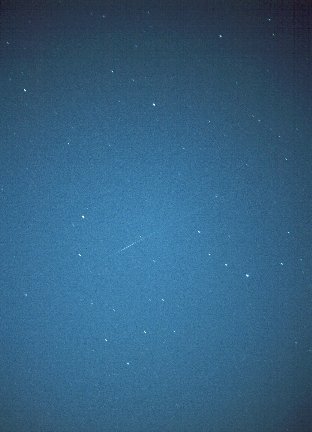
Iridium Flare, taken by David Forshaw at 23:38:35 BST on 28th June, 1998. Iridium 64, Magnitude -6.4, Elevation 42°, Azimuth 257° (W) Taken on AgfaCT200 slide film at f1.4. Taken 2 seconds before and after flare. Average total exposure time 9-10 seconds.
Iridium Flare, taken by David Forshaw at 23:29:37 BST on 1st July, 1998. Iridium 63, Magnitude -6, Elevation 37°, Azimuth 263° (W) Taken on Agfa CT200 slide film at f1.4. Taken 2 seconds before and after flare. Average total exposure time 9-10 seconds.
Iridium Flare, taken by David Forshaw at 23:17:50 BST on 6th July, 1998. Iridium 74, Magnitude -1, Elevation 30°, Azimuth 275° (W) Taken on Agfa CT200 slide film at f1.4. Taken 2 seconds before and after flare. Average total exposure time 9-10 seconds.
Iridium Flare, taken by David Forshaw at 23:11:49 BST on 7th July, 1998. Iridium 70, Magnitude -6, Elevation 30°, Azimuth 275° (W) Taken on AgfaCT200 slide film at f1.4. Taken 2 seconds before and after flare. Average total exposure time 9-10 seconds.
Iridium Flare, taken by David Forshaw at 23:13:25 BST on 16th July, 1998. Iridium 70, Magnitude -7, Elevation 14°, Azimuth 298° (NW) Taken on Agfa CT200 slide film at f1.4. Taken 2 seconds before and after flare. Average total exposure time 9-10 seconds.
All times are in BRITISH SUMMER TIME (BST). Times For Observer in Liverpool, Merseyside, England, U.K.
Latitude 53 degs 24 mins North.
Longitude +3.0 degs West.
Mercury is at superior conjunction with the Sun on the 25th, however it can be seen almost 2° South of Jupiter on the 1st of the month low in the West.
VENUS.
Venus is still riding high in the West after Sunset. Asthis celestial searchlight moves closer to the Earth its apparent size increases from 16″ at the start of the month to 21″ at the end with its phase decreasing to just under half. During May Venus leaves the constellation of Taurus and enters Gemini. Details below give the planet’s conjunctions with some of the brighter objects there. On the 18th at 16h:00m the Moon Passes 6° South of Venus.
9th 1.5 degs North of M35 (Open Cluster). 10th 3degs North of Eta Geminorum. 12th 3degs North of Mu Geminorum.
17th 41″ North of Epsilon Geminorum. 25th 3degs North of Delta Geminorum. 25th 3degs South of lota Geminorum.
28th 2.5 degs South of Upsilon Geminorum. 29th 32″ South of Kappa Geminorum.
MARS.
Mars is a nice evening object,transiting at just before midnight at mid-month. Its diameter decreases slowly as it starts to move away from the Earth. On the 26th at 14h:00m Mars lies 4° South of the Moon. MARSWATCH – latest observations of the red planet.
ASTEROIDS.
Juno is at opposition on the 24th.
Ceres is 0.7° North of Venus on May 5th. For More information on Asteroids Click Here.
JUPITER.
By the end of the month Jupiter starts to show again in the morning sky, passing 4°.5 North of the Moon on the 13th in the constellation of Pisces.
Launched in October 1989, the Galileo Jupiter Probe entered orbit around the great planet on December 7th 1995. The Project Galileo Homepage will give you up-to-date information and the very latest images returned.
SATURN.
Saturn is still too close to the Sun for observations.
URANUS and NEPTUNE.
Uranus begins retrograde (Westward) motion during May among the stars of Capricornus. It shines at Mag 5.8.
 Positions for the 1st May:

                          R.A.                   DEC                    TRANSIT TIME           MAG
                      22h:17m:07s           -16°:29':23"                   06h:54m             5.8
Bluish Neptune is also in Capricornus at this time, just two binocular fields west of Uranus. In early May it is less than 1° Southwest of the star Pi Capricorni
 Positions for the 1st May:

                          R.A.                   DEC                    TRANSIT TIME           MAG
                      20h:26m:29s           -18°:53':21"                   06h:04m           7.9
PLUTO.
Best time to look for the almost 14 mag planet is around New Moon. The dates below will be a guide for planning observations.
Positions for May are when pluto's elongation angle is greater than 90°.

DATE                      R.A.                   DEC                   TRANSIT TIME
May  1st               16h:37m:22s            -10°:05':37"                 03h:18m
May  11th              16h:36m:25s            -10°:02':44"                 02h:38m
May  21st              16h:35m:24s            -10°:00':19"                 01h:57m
On May 31st Pluto at 13.4 Mag reaches opposition in Ophiuchus. It can be found less than 0.5° North of the star Zeta Ophiuchi. You will need an 8-inch or larger telescope and the best time to see Pluto is when the Moon is not around. It is best seen between May 8th – May 22nd.
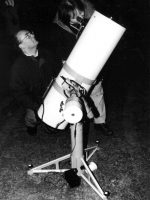
The Telescope mount extension is constructed from a ½ thick 7″ inch diameter mild steel pipe that has two 3/8th” thick plates welded either end. These plates are same length and breath as the orginal grey top plate of the telescope pillar. There are four tubular sections, 1¼ diameter, welded at the four corners. The pillar stands at 3 feet (1 metre) high. The weight of this extension requires at least two people to carry it!
The purpose of the extension is to test out several different telescope designs/sizes to see if the vibration problems inherent in the building can be visibly reduced by using a more compact telescope such as a Meade 12″ Schmidt-Cassegrain instead of the tall 16″ Robertson Newtonian Reflector that we have struggled with over the years.
In recent weeks, we have tested out an 8″ Meade LX200 at X165 Mag and found that direct vibration from the floor stops at 5 secs, whilst from the pillar, dead at 7 seconds. This I feel is a vast improvement from the 20 seconds plus with the 16″ telescope. Finding and tracking was much easier. Over a dozen deep sky objects were observed in my first hour of testing, and they stayed in the centre of the scope. Bare in mind that it was not polar aligned and therefore not working at its optimum design.
The newly purchased CCD video camera was also used at this time, and showed that stellar objects could be positioned on the CCD chip and tracked, further testing in the coming weeks will hopefully include a 10″ and 12″ Meade LX200.My Thanks must be noted to LAS members Christos Spyrou who made available his telescope, and Steve Southern who helped me install the telescope mount at the Observatory.
CCD Imaging Trial – April 22nd 1999
Report by Rob Johnson
Would it or wouldn’t it?
Since the opening of The Pex Hill Observatory 5 years ago the big question has remained, with a suitably equipped instrument would the stability of the building be sufficent to allow serious astrophotography or CCD imaging through a telescope. As most members are now aware, despite extensive work, the 16″ Robertson reflector would never be a first class observatory instrument so the search was on for a replacement. Dave Galvin and Geoff Regan had started to arrange for different sizes and types of telescopes to be placed in the observatory and assessed for their potential usefulness. This would be an essential step before the Observatory sub-committee and council would splash out on a new telescope.
Now the interesting bit. I had a call tea-time from Geoff Regan “It’s going to be clear – will you come up to Pex Hill and try out some CCD imaging?”
Christos Spyrou had very kindly brought his 8″ f10 Meade LX200 and set it up on the new steel test pillar put in place by Dave Galvin & Steve Southern. Dave Owen, Chris Banks, Geoff Regan, myself and DG assembled under a clear sky with a first quarter Moon. The CCD was plugged in and Christos Spyrou started to align the telescope – you can guess what happened next – clouds swept in from the South-West to cover the sky! Chris frustratingly attempted to get an alignment for the alt-az mount on two stars, eventually he obtained an approximate alignment, which enabled the telescope to be roughly pointed at any object with the software.
For a couple of hours we dodged the clouds to capture brief exposure tests on various objects, M3, M64, M66, M95. It Quickly became clear that the supporting structure was stable enough to allow images of at least 30 seconds duration to be taken, this may not seem very long but CCD images can be easily “stacked” together to produce much longer effective exposures. Towards midnight we had a good clear slot sufficient to complete our tests. The image of M3 was surprisingly good considering the poor conditions and goes to prove what could be done. The Pex Hill Observatory was not quite as jelly-like as some of us had feared after all.
Now the technical bit. The CCD was a Starlight Xpress mono parallel port camera with 12×16µ pixels, this gave an image scale of around 1.4 arc seconds per pixel, this is considered about the correct sampling size for typical seeing conditions. At f10 the telescope was slower than ideal for imaging, a faster f-ratio, by design or by use of a focal reducer, would produce a higher rate of signal and allow a good signal to noise ratio to be obtained in a shorter time.
Exposures were taken increasing from 5 seconds upwards. At 30s images showed round stars with no trace of vibration even when Chris Banks exited via the observatory trap door during the exposure. Despite high winds, at times entering the dome slit, the system proved able to cope. Exposures over 30s were slightly trailed due to the lack of accurate telescope alignment and stacked images showed field rotation because the telescope was mounted alt-az. Both of these problems would be absent in a permanently set up equatorially mounted telescope. Most of the images showed somewhat bloated stars due to poor seeing conditions, this I suspect was mainly due to the incoming weather system, though observatory domes are notorious for producing turbulent air, this will always be a factor at Pex Hill.
It was not possible to fully assess the pointing accuracy of the Meade because of the lack of correct alignment, however, most objects were very close to if not on the CCD chip most of the time. The periodic error of the drive was assessed from the image movement on multiple CCD frames and found to be no more than a few arc seconds.
It was a very exciting and enjoyable evening at Pex Hill where we answered our long-standing question – yes we will be able to do serious imaging – supernovae searches, asteroid positional measurement and lots more. All we need now is a first class telescope!
Many Thanks to everyone who helped with the testing
Geoff Regan, LAS Director of the Observatory
Although Mercury reaches greatest Western elongation this month on the 6th, it is not favourable placed for observers in the Northern Hemisphere.
VENUS.
Venus is most definitely at its best now.Over 25° above the Western horizon at the time of evening civil twilight. Venus passes 2.5° South of the Pleiades star cluster in Taurus on the 14th so binocular observers will have the advantage over telescope owners in viewing this wide-field event. A 200mm telephoto lens with fast (in excess of 400ASA) film in the camera will record the passing with an exposure of around 20s although there will be a small amount of trailing ifthe camera is not tracked throughout the expsure. Asthe planet tracks through Taurus it passes North of the naked-eye stars Upsilon,Kappa, and Tau Tauri on the 20th, the 20th again and the 23rd respectively. At the end of the month the planets’ disk is 16″ across and shows a phase of 69%.
MARS.
Mars is at opposition on the 24th and speeds up its motion in Virgo.
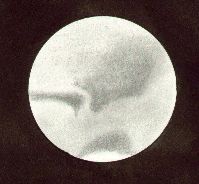
Mars, drawn by Ken Clarke, as viewed through a 10″ F4.3 Reflector 308x,432x. w=14.4, seeing 3-5, at 00:00 UTC on November 4th, 1990
In February Mars passed between the stars kappa and Lambda Virginis and this month, with the planet having changed direction, it encounters them again. On the 16th mars is 1°North of Lambda, and on the 23rd 1.5° South of Kappa. Binoculars offer a very poor view of Mars due to its small size – it is only 4,200 miles across – so a telescope capable of usefully using a high magnification is necessary to see any surface details. The use of blue filters at the eyepiece will increase contrast amd make the pastel shades of the features stand out slightly better.Mars shows a disk 15″ across,but in August 2003 the disc will be 25″ across. On the 30th at 00h the Moon passes 3° South of Mars.
MARSWATCH – latest observations of the red planet.
ASTEROIDS.
Juno is stationary on the 1st of April.
Pallas is in conjunction with the Sun on April 20th.
Metis is at apposition at Mag 9.9 in Virgo on April 19th.
Jupiter is at solar conjunction with the Sun on April 1st, but will appear in the morning sky near the end of the Month.
Launched in October 1989, the Galileo Jupiter Probe entered orbit around the great planet on December 7th 1995. The Project Galileo Homepage will give you up-to-date information and the very latest images returned.
SATURN.
As with Jupiter, Saturn is at solar conjunction but on the 24th April.
URANUS and NEPTUNE.
Uranus is slowly recovering from its February solar conjunction, and can be seen at Mag 5.8 in Capricornus.
Positions for the 1st April

                          R.A.                   DEC                    TRANSIT TIME           MAG
                      21h:13m:40s           -16°:43':46"                   08h:49m             5.8
Like Uranus, Neptune is recovering from its solar conjunction and at mag 7.9 the approaching twilight will hinder chances of locating this outer planets.
 Positions for the 1st April

                          R.A.                   DEC                    TRANSIT TIME           MAG
                      20h:25m:04s           -18°:58':09"                   08h:00m             7.9
PLUTO.
Pluto can be found on the border of Ophiuchus and Scorpius, above and to the right of the mag 2.6 star Zeta Scorpii. The best time to look for the planet is around New Moon. The dates below will be a guide for planning observations.
Positions for April are when pluto's elongation angle is greater than 90°

DATE                      R.A.                   DEC                   TRANSIT TIME
April  1st             16h:39m:18s            -10°:15':43"                 05:18
April 11th             16h:38m:50s            -10°:12':15"                 04:38
April 21st             16h:38m:10s            -10°:08':50"                 03:58
Pluto is best seen between April 9th – April 23rd.
April 28th ALPHA SCORPIIDS (20 per hour) Favourable.
COMETS.
Comet C/1999 H1 (Lee) discovered April 16th by Steven Lee Australia.
Will reach North Hemisphere in early May in Hydra into Cancer. Expected to reach Mag 7 when it reaches perihelion in early July.
Comet Schorr at Perihelion on April 3rd (2.847AU).
Comet Singer-Brewster at Perihelion on April 6th (2.0232AU).
Plus these pages will give daily and weekly reports of this and other Comets progress.
On the 20th March we celebrated 5 years at Pex Hill and to mark this event we had an open day and evening at Pex Hill. Over 200 members of the public turned up over the whole day. There were enterained with views through members telescopes of the Sun and slide shows in the classroom. Dave Galvin, showed weather satellite images on the society 486 computer. Steve Southern, used a computer projection system to show members of the public what to look out for in the night sky, and Eric Jones gave a talk on the August 11th Eclipse.
LAS member Dave Forshaw used his C5 Celestron with a 1000 Oaks Sun filter to show the Sun. Dave also did a talk which he titled The Restless Sky. Tony Williams did a talk and slide show about his recent visit to COAA in Portugal, my personal favourite image was M46 which is an open cluster in Puppis. This open cluster contains a planetary Nebula near its Northern Edge.
Dave Owen showed members of the public the 16 inch Roberson reflector. Juan Rivero brought his 6 inch F6 Reflector on a Vixen mount with a Sky sensor. Chris Spyrou also brought his 8-inch Meade LX200 which he used with a Mylar filter to observe the Sun. Colm Jackson also brought along his computer and showed off his very impressive Space Art. Rob Johnson set up his Starlight Express CCD Camera and showed members of the public how CCD imaging is done.
In the evening we were let down by the weather and unfortunately we were not able to use the telescopes, but thankfully it did not rain and the barbecue went really well for those of us who cooked the food properly. Because of the weather the evening schedule relied heavy on talks and slide shows.
On a personal note I would like to thank all LAS members who helped on the day and give a special thanks to my wife Beverly without who’s understanding I would not be able to do these events.
Mar 27th – BAA Special General Meeting (link removed as URL is invalid) followed by the Ordinary Meeting. 14:30 – 17:30.Savile Row, London.
Mar 28th – Regulus 0.3° South of Moon.
Mar 28th – British Summer Time Begins (TBC).
Mar 30th – The Astronomer Royal to give the 10th Leverhulme Memorial Lecture: Our Universe & Others at 17:30 at Liverpool University. Tickets from G.Gilligan.
Mar 31st – Blue Moon, second full moon of the month.
March 21st marks the date of the Spring Equinox when the Sun crosses the celestial equator in Pisces heading North. March is also the month when the clocks are traditionally advanced by one hour in Britain to take us into British Summer Time. As far as this page is concerned, you will have to added one hour to any times stated to obtain BST.
Mercury is at its best in the evening sky this month. with it lying in the rather faint constellation of Aquarius there are no bright stars around to confuse you when trying to indentify the planet. Wait until half an hour after the Sun has set and slowly scan the Western horizon with binoculars, moving up slightly after each sweep.
Planets on view in the South-Western evening sky, February – March 1999
Placing the binoculars on a camera tripod should assist in this. Mercury will soon give its location away by being the first ‘star’ to show itself (apart from Venus and Jupiter which are higher up and much, much brighter) as the sky darkens. On the 19th Mercury is back at the Sun for an Inferior conjunction.
VENUS.
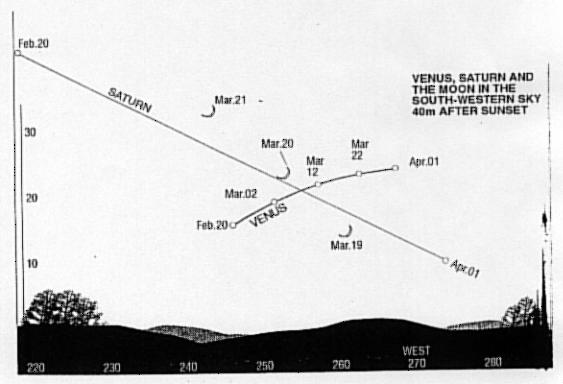
On the 20th the Moon passes a wide 6° South of Venus as they travel through the constellation of Pisces, presenting an excellent opportunity for a photographic record. Also on the 20th Venus and Saturn lie 2.5° apart, Venus being the much brighter of the pair.
Venus, Saturn and the Moon in the South-Western evening sky, February – March 1999
MARS.
Mars is very well placed in the early eveing sky. You should by now br familiar with its position against the background stars of Virgo as it tracks to the East. Note though that this month Mars slows its apparent motion and early in April starts to move Westwards. This is known as Retrograde motion and is a phenomenon caused by the Earth orbiting the Sun at a faster rate than Mars. Using background stars as a reference the Earth overtakes Mars and starts to head away leaving Mars lagging behind. After a period of a couple of months or so normal prograde motion resumes. On the 7th Mars is 2° South of the Moon.
MARSWATCH – latest observations of the red planet.
ASTEROIDS.
8 Flora can be found in Virgo at Mag 10 during the month. Its at opposition on March 23rd.
Jupiter is now unfavourably close to the Sun for observations.
Launched in October 1989, the Galileo Jupiter Probe entered orbit around the great planet on December 7th 1995. The Project Galileo Homepage will give you up-to-date information and the very latest images returned.
SATURN.
Saturn, its brief dalliance with Venus now over, will soon move too close to the Sun to be observed.
URANUS and NEPTUNE.
Both outer planets are unfavourable for observations at this time.
PLUTO.
Pluto can be found in Ophiuchus, above the 2nd magnitude star Zeta Ophiuchi. The best time to look for the planet is when the Moon is not around. With this in mind the dates given below, calculated as either side of the New Moon, maybe used as a guide for planning an observing session.
Best seen between March 10th and March 24th.
The Positions have been calculated for every ten days at 00h U.T. throughout the period of March 1999 when Pluto's elongation angle is greater than 90°.
 Positions are for Epoch 2000.
Date                        R.A.                DEC              TRANSIT              ELG
                           h  m  s           °     '  "           Time                 °
Mar 2nd                   16 39 26          -10    24 57         06h:16m              091
Mar 12th                  16 39 37          -10    22 13         05h:37m              100
Mar 22nd                  16 39 34          -10    19 05         04h:47m              110
METEORS.
No Major showers during March.
COMETS.
Mar 4th – Comet P/1998 U4 (Spahr) at Perihelion (3.826 AU).
Mar 7th – Comet P/1998 U3 (Jager) at Perihelion (2.153 AU).
Mar 8th – Comet Tsuchinshan II at Perihelion (1.771 AU).
Mar 9th – Comet Skiff-Kosai at Perihelion (2.789 AU).
Mar 16th – Comet Shoemaker I at Perihelion (1.979 AU).
Mar 21st – Comet Mueller III at Perihelion (3.010 AU).
Plus these pages will give daily and weekly reports of this and other Comets progress.
All times are in GMT the same as U.T. Times For Observer in Liverpool, Merseyside, England, U.K.Latitude 53 degs 24 mins North.
Longitude +3.0 degs West.
          31st Jan     5th Feb      10th      15th      20th      25th      2nd Mar
SUNRISE    07:59        07:50      07:41     07:31     07:20     07:09       06:58
SUNSET     16:53        17:03      17:13     17:23     17:32     17:42       17:52
PHASES OF THE MOON DURING FEBRUARY 1998
NEW MOON
on 16th at 06h:40m
FIRST QUARTER
on 23rd at 02h:44m
FULL MOON – –
LAST QUARTER
on 8th at 11h:59m
FULL MOONLESS FOR FEBRUARY!
After January’s double full moon, February manages to skip a full moon. At 28 days, its the only month short enough to accomplish this feat.February last lacked a full moon in 1961 and will miss one again in 2018. After January,the first full Moon will be on March 2nd followed by another blue Moon on March 31st.
THE PLANETS THIS MONTH.
MERCURY.
Mercury is at superior conjunction on the 4th but swiftly rises in the evening skyto reach a maximum altitude of over 10° early in March. This table and the diagram below should enable you to locate this surprisingly bright planet, especially as Venus and Jupiter are higher up and the Moon comes very close on the evening of the 17th. Mercury also passes close to some faint stars in Aquarius throughtout the apparition.
Click to enlarge – Planets on view in the South-Western evening sky, February – March 1999
Venus starts to become entangled with Jupiter in February and a quick glance thrugh a telescope will show the vest difference in size between the two planets. Venus, quite close to us (1.48AU mid month were 1AU is equivalent to approximately 93 million miles) appears as a 12″ disk whlist Jupiter (5.72AU away appears nearly 3x larger at 34″ across. On the 24th the two planets are only 8′ apart so a low power eyepiece on a telescope or a pair of 10×59 binoculars will show them both in the same field of view.A series of short exposure photos (4 to 6 seconds on 400 ASA film) taken a day or so apart will record this celestial ballet with the Moon putting in a cameo appearnace on the 17th & 18th, passing 2.5° South of Venus on the 18th at 07h:00m.
Venus and Jupiter in pre-dawn sky at 06:30 U.T. January 26th 1995
Mars’ apparent diameter is slowly increasing as it approaches the Earth for an April apposition. Passing through the large constellation of Virgo, the red planet passes South of the Naked eye star Kappa Virginis on the 7th and North of lambda Virginis, anotherStar visible to the unaided eye, on the 15th. Also on the 7th Mars is 2° South of the Moon.
MARSWATCH – latest observations of the red planet.
ASTEROIDS.
Vesta is at Opposition on February 4th at Mag 6.2 and can be found on the Leo/Cancer border, moving into Cancer in March.
Jupiter, as mentioned above, is associated briefly with Venus, the two planets heading off in different directions after their February 24th encounter, Venus risubf to even greater heights with Jupiter heading towards an April 1st appointment with the Sun. On the 18th at midnight Jupiter is 3° North of the Moon.
Launched in October 1989, the Galileo Jupiter Probe entered orbit around the great planet on December 7th 1995. The Project Galileo Homepage will give you up-to-date information and the very latest images returned.
SATURN.
Saturn, half the diameter of Jupiter at the Moment is slightly more favourable but soon it too will descend into the evening murk. On the 20th Saturn is just over 3° North of the Moon.
URANUS and NEPTUNE.
Uranus is at solar conjunction on February 3rd and Neptune is still unfavourable for observations until May/June.
PLUTO.
Pluto will be out of view until the end of March.
PLEASE NOTE:
On the 11th February Pluto will cross the orbit of Neptune and once again, after 20 years, becomes the farthest planet from the SUN.
METEORS.
February 3rd and 13th Alpha Aurigids ZHR is 12 per hour. ( Fairly favourable)
COMETS.
Comet C/1998 W3 (LINEAR) is at Perihelion on Feb 9th at (4.863 AU).Plus these pages will give daily and weekly reports of this and other Comets progress.
The Setting Sun behind the Liverpool’s Anglican Cathedral. Photographed from Mersey heights, Frodsham. Taken via prime focus through a Celestron C5 Telescope, f10. Using Agfa 200 slide film, by David Forshaw, May 23rd, 1997
David Forshaw’s Astronomy Homepage (link removed as URL is invalid)
Noctilucent Clouds photographed by David Galvin
Noctilucent clouds, taken by David Galvin on June 23rd/24th 1995 at 03:30 BST (02:30 UT) 30/40 sec exps, 50mm standard lens at f2 200 ASA colour print film. The bright star is Capella.
Noctilucent clouds, taken by David Galvin on June 23rd/24th 1995 at 03:30 BST (02:30 UT) 30/40 sec exps, 50mm standard lens at f2 200 ASA colour print film. The bright star is Capella.
Saturn and satellites, drawn by Geoff Regan, using an 8″ f6 (200x and 266x) at 23:59 UTC on 8th/9th October, 1995. At full moon, seeing V. Good, air steady.
M56 CCD image taken by Mr. Rob Johnson using Mr Eric Strach’s Xpress SXL8 CCD Camera on 16th June 1996 Exp. 8mins. Very hazy night, limiting mag ~2 – 3.
M11 CCD image taken by Mr. Rob Johnson using Mr Eric Strach’s Xpress SXL8 CCD Camera on 24th June 1996 Exp. 2mins in twilight with the Moon low in the Western sky
Barnard’s Star – Clearly shows motion over 5 years. Photo (left) taken in 1991, CCD image (right) taken 24th June 1996, exp. 30secs. Both images taken by Rob Johnson with a 14″ Reflector
NGC 7331 CCD image taken by Mr. Rob Johnson using Mr Eric Strach’s Xpress SXL8 CCD Camera on 25th June 1996 Exp. 8mins. Twilight sky, Sun -13 degs, no moon
Comet Hyakutake C/B2 1996 image by Mr. Rob Johnson on 10th April 1996 Exp. 10mins with 178mm f4. From Formby Beach, Merseyside, U.K. Printed on grade 3.5 paper