Images from COAA Trip October 1998

Dust Lanes of M31. 20″ f4.5 reflector. Ektachrome 400.10mins (+ I.P.), Tony Williams’ COAA Trip, October 1998
Visit The C.O.A.A. Homepage
If you can see this message then you are using a browser (probably Internet Explorer) which does not support the international web standards used by the LAS website and many others.
Click here for an example of how the site should look.
Please consider using an alternative browser - especially if you are on Windows XP which only supports the outdated Internet Explorer 8 browser - such as Mozilla Firefox or Google Chrome which do have support for these web standards. As well as not supporting modern features and web standards, old versions of browsers - especially Internet Explorer - can expose your computer to security risks. The Browse Happy website has a list of the latest versions of all major browsers, including Internet Explorer (but remember Windows XP only supports up to IE8!)
If updating/changing your browser is not possible, do not panic - all of the LAS website is still available to you and we are working to make the layout compatible with outdated browsers.
In the meantime, you will have to scroll down a way to see the page you wish to view. You can also skip past the moon phase info, etc. and click here after you've loaded a page to jump to the content.

Dust Lanes of M31. 20″ f4.5 reflector. Ektachrome 400.10mins (+ I.P.), Tony Williams’ COAA Trip, October 1998
Visit The C.O.A.A. Homepage
Clear & Dark Skies for 1999 from all at Liverpool A.S.
Will it be cloudy to-night?, ask the The U.K. Goverment Met Office Weather service.
To make your own star chart fo your location at any time, Click Here.
All times are in GMT the same as U.T. Times For Observer in Liverpool, Merseyside, England, U.K.
Latitude 53 degs 24 mins North.
Longitude +3.0 degs West.
1st 6th 11th 16th 21st 26th 31st SUNRISE 08:27 08:26 08:23 08:19 08:13 08:06 07:59 SUNSET 16:04 16:10 16:17 16:25 16:34 16:44 16:53
| PHASES OF THE MOON DURING JANUARY 1999 | ||||
| FULL MOONon 2nd at 02h:50m |
LAST QUARTERon 9th at 14h:23m |
NEW MOON>on 17th at 15h:47m |
FIRST QUARTERon 24th at 19h:16m |
FULL MOONon 31st at 16h:08m |
On the 3rd the Earth is at Perihelion – the closest distance to the Sun in 1999. It is at a distance of 0.983280 (AU Astronomical Units).
On the 31st there will be a penumbral eclipse of the Moon. Penumbral eclipse are relatively unexciting when compared with partial or total lunar eclipses as the Moon only passes through the Earth’s partial shadow – the penumbra. This months event is even more undistinguished with the fact that the eclipse starts before the Moon rises. The eclipse ends at 18h:30m, the Moon having risen some 1 hour 36 minutes earlier.
Mercury finishes off a morning apparition which was at its best between December 12th – 22nd 1998. This Table gives more details. (link removed as URL is invalid)
Venus is becoming a favourable evening object low down in the South West approximately 40 minutes after Sunset. At almost full phase on the opposite side of the Sun as seen from the Earth, it presents a disk only 11″ of arc across throughout the month. As the apparition progresses towards gibbous phase in April it will appear larger ar 14″ and in mid-June when it is almost between the Earth and the Sun it will show a half phase of 27″ diameter. On the 19th Venus is 1° North of the Moon.
Mars is at Western quadrature half way through January which means that it lies 90° to the West of the Sun, moving further away from the Sun and closer to the Earth all the time. Using a high magnification with a telescope you may notice that one side of the disk does not appear sharp. In fact, because the planet is at a right-angle with the Sun from our view point we are not looking square on to the sunlit hemisphere but are peeking around the corner, so to speak, and are seeing part of the night side of Mars. The bright star lying approximately 4° South of Mars on the 11th is Spica – Virgo’s primary star.
MARSWATCH – latest observations of the red planet.
Ceres at mag 7.7 can be found in Taurus and Vesta at mag 6.9 in Leoduring the month.
For More information on Asteroids Click Here.
Jupiter is moving swiftly through Pisces and descends into the Western evening twilight with the Moon passing 2.5° South on the 22nd. Its diameter is decreasing as it moves further away from us and appears 35″ across by the end of the month.
Launched in October 1989, the Galileo Jupiter Probe entered orbit around the great planet on December 7th 1995. The Project Galileo Homepage will give you up-to-date information and the very latest images returned.
Saturn too, is heading towards the Sun, passing 3° North of the Moon on the 24th and under 1° South of the star Omicron Piscium on the 30th. Diameter at mid-month is 18″.
Both outer planets are at Solar conjunction this month, and are unfavorable for observations at this time. Neptune is at Solar Conjunction on the 22nd.
Pluto is unfavourable placed for observations and will be out of view until mid-March.
QUADRANTIDS 80 per Hour ZHR – max on the 4th (UnFavorable – Full Moon on 2nd).
Plus these pages will give daily and weekly reports of this and other Comets progress.
Will it be cloudy to-night?, ask the The U.K. Goverment Met Office Weather service.
To make your own star chart fo your location at any time, Click Here.
All times are in GMT the same as U.T. Times For Observer in Liverpool, Merseyside, England, U.K.
Latitude 53 degs 24 mins North.
Longitude +3.0 degs West.
2nd 7th 12th 17th 22nd 27th 2nd Dec SUNRISE 07:12 07:22 07:31 07:40 07:49 07:58 08:06 SUNSET 16:38 16:29 16:21 16:13 16:06 16:01 15:57
| PHASES OF THE MOON DURING NOVEMBER 1998 | ||||
| NEW MOON on 19th at 04h:28m |
FIRST QUARTER on 27th at 00h:24m |
FULL MOON on 4th at 05h:19m |
LAST QUARTER on 11th at 00h:29m |
|
On the 4th the Moon is at its minimum perigee (closest to the Earth) in 1998 at a distance of 356,614 km.
Even though Mercury is at its greatest elongation on the 11th it is very poorly placed for observers in the Northern hemisphere.
Venus is also poorly placed but will soon start an evening apparition which will see it into 1999.
On the 13th Mars is only 18′ North of the Moon at 18h:00m. By the time it has risen though (at 01h:45m) the following morning), the gap will have widened considerably. As the years ends Mars’ diameter will increase to over 6″ and careful telescope observers will note that the disk is not a perfect circle but exhibits a slight “gibbous” phase. In fact, only 90% of the planet’s sunlit hemisphere is turned towards the Earth this month.
MARSWATCH – latest observations of the red planet.
For More information on Asteroids Click Here.
Jupiter’s apparent diameter is decreasing but at 42″ is still eight times larger than Mars. On the 28th the Moon passes 1° to the South.
Launched in October 1989, the Galileo Jupiter Probe entered orbit around the great planet on December 7th 1995. The Project Galileo Homepage will give you up-to-date information and the very latest images returned.
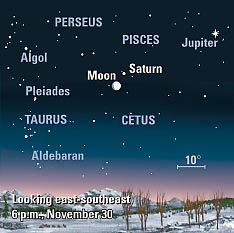
Saturn is very nicely placed in the evening sky. After the Sun has set it may be found low down in the South East, but before midnight is due South near to the star Alpha Piscium. On the 30th Saturn is 2.5° North of the Moon.
Both are now less than 90° away from the Sun, and must be considered as unfavorable for observations at this time.
Pluto is in conjunction with the Sun on the 30th and will be out of view for several months.
TAURIDS 12 per Hour ZHR – max on the 3rd (Favorable) and 13th (Unfavourable).
LEONIDS 1998 STORM – max on the Nov 17th/18th Possible Storm. (Favourable)
Plus these pages will give daily and weekly reports of this and other Comets progress.
Will it be cloudy to-night?, ask the The U.K. Goverment Met Office Weather service.
To make your own star chart fo your location at any time, Click Here.
All times are in British Summer Time (B.S.T.). But Please note that at the end of the month the clocks are put back one hour to take us into GMT.
Therefore subtract one hour from the times stated here to obtain GMT. Times For Observer in Liverpool, Merseyside, England, U.K.
Latitude 53 degs 24 mins North.
Longitude +3.0 degs West.
3rd 8th 13th 18th 23rd 28th 2nd Nov SUNRISE 07:17 07:26 07:35 07:44 07:53 08:03 08:12 SUNSET 18:45 18:33 18:21 18:10 17:59 17:48 17:38
| PHASES OF THE MOON DURING OCTOBER 1998 | ||||
| NEW MOON on 20th at 11h:10m |
FIRST QUARTER on 28th at 12h:47m |
FULL MOON on 5th at 20h:13m |
LAST QUARTER on 12th at 12h:12m |
|
On the 21st the Moon is at its maximum apogee (furthest from the Earth) for 1998 at a distance of 406,669km.
Mercury was at superior conjunction late last month and is not on view at the moment.
Venus is also out of the picture as it reaches superior conjunction on the 30th.
Mars’ apparent diameter is now 4.6″ towards the of the month. Whilst nowhere near its best for observation, owners of telescopes capable of usefully applying a high magnification may note one of the white polar caos against a tiny orange disk. On the 6th Mars lies 1° North of the star Regulus (Alpha Leonis) – a star Mercury passed last month. On the 16th the Moon passes 1.5° South of Mars.
MARSWATCH – latest observations of the red planet.
20 MASSALIA is at oppostion on the 30th at Mag 9.0 in the constellation of Aries.
For More information on Asteroids Click Here.
JUPITER.
Jupiter will be a fine sight for the rest of this year with the Moon passing 1° South on the 4th.
Launched in October 1989, the Galileo Jupiter Probe entered orbit around the great planet on December 7th 1995. The Project Galileo Homepage will give you up-to-date information and the very latest images returned.
Saturn is at opposition on the 10th and passes 2.5° North of the moon on the 7th.
Both are still with us, but by months end are hiding in the South Western horizon’s murk, within the constellation of Capricornus . Uranus should be visible through binoculars under a clear, dark sky sets at 23h:30m, but Neptune may need further resolving power – i.e. a telescope – to distinguish it from a star.It sets at 22h:40m.
Planet Postions During October 1998
Uranus Oct 1st R.A. 20h:46m:14s DEC -18°:39':58" Mag 5.7 Neptune Oct 1st R.A. 20h:06m:01s DEC -19°:56':53" Mag 7.9
Tiny distant pluto is now very poorly placed for observations from Liverpool. Please note even at opposition Pluto reaches 13.7 Mag.
13th Piscids Low Rates Fairly Favouable (8 day old Moon) 21st Orionids 20 Per Hour Favourable (1 day old Moon)
Plus these pages will give daily and weekly reports of this and other Comets progress.
Will it be cloudy to-night?, ask the The U.K. Goverment Met Office Weather service.
To make your own star chart fo your location at any time, Click Here.
All times are in BRITISH SUMMER TIME (BST). Times For Observer in Liverpool, Merseyside, England, U.K.
Latitude 53 degs 24 mins North.
Longitude +3.0 degs West.
3rd 8th 13th 18th 23rd 28th 3rd Oct SUNRISE 06:24 06:33 06:42 06:50 06:59 07:08 07:17 SUNSET 19:57 19:45 19:33 19:21 19:09 19:57 18:45
| PHASES OF THE MOON DURING SEPTEMBER 1998 | ||||
| FIRST QUARTER
on 28th |
FULL MOON
on 6th |
LAST QUARTER
on 13th |
NEW MOON
on 20th |
|
The autumn equinox occurs on the 23rd. This is when the Sun crosses the celestial equator heading south towards the winter solstice in December. At this time, from any point on the Earth’s Surface day and night are of Equal length
At the start of the month Mercury can be found nearly 10° above the North East horizon about 45 minutes before sunrise. On the 8th Mercury is 49′ North of the naked eye star Regulus in the constellation of LEO and on the 11th at 05h:00m Mercury is 20′ North of Venus.Superior conjunction is on the 25th.

Diagram of Morning Sky Apparition of Mercury – August/September 1998
Click On Map for further details.
Venus speeds towards the Sun but it will be visible above the eastern horizon almost up until sunrise until early next month. On the 19th at 19h:00m Venus lies 1° North of the Moon.
On the 1st of the month Mars passes a mere 30′ South of the open star cluster M44 in Cancer. Try to observe every morning a week before and a week after to catch a rather swift passage. As Mars does not rise until 03h:00m you will need to be an early riser.!
MARSWATCH – latest observations of the red planet.
A bonus for observers of Jupiter this month is that one of the largest asteroids pays it a visit this month. This small map shows PALLAS tracking southwards, passing less than a degree North of Jupiter on the 23rd. A series of observations with binoculars or a telescope. recorded either on paper or on film, will reveal the asteroid’s changing position with respect to Jupiter and background stars of Aquarius.
Finder Chart for Pallas near Jupiter.From Sky Publishing com.
For More information on Asteroids Click Here.

Jupiter, drawn by Ken Clarke, as viewed through a 10″ F4.3 Reflector, 308x. w1=54deg, w2=141deg, seeing 2/5, at 21:00 UTC on April 22nd, 1991
Drawing of Jupiter © Ken Clarke.
Talking of Jupiter, the giant gas planet is at opposition on the 16th and now is therefre the best time to make use of a large bright disk, to observe the Solar System’s largest planet and the ever-changing positions of its four largest moons. Even a pair of 10×50 binoculars will reveal the disk and the satellites.
Launched in October 1989, the Galileo Jupiter Probe entered orbit around the great planet on December 7th 1995. The Project Galileo Homepage will give you up-to-date information and the very latest images returned.
Saturn rises well before midnight now and passes 3° North of the Moon on the 9th in the constellation of Pisces.
Both outer gas planets are still favourable objects during the month.
Uranus can be found due South at 22h:20m in the constellation Capricornus.
Neptune is much fainter than Uranus and is more of a challenge to locate and observe. Laying due South at 21h:30m in the constellation Sagittarius.
Uranus Positions for the 1st September:
R.A. DEC TRANSIT TIME MAG
20h:49m:15s -18°:28':42" 22h:20m 5.7
Neptune Positions for the 1st September:
R.A. DEC TRANSIT TIME MAG
20h:07m:39s -19°:51':20" 21h:30m 7.9
Pluto is now not favourable for observations until next year.
Plus these pages will give daily and weekly reports of this and other Comets progress.

The Moon, taken by Colin Murray on 18th April 1997 at 23:20BST
1/180th sec expos,camera projection
30x 8″ reflector f/6
kodachrome 200 ISO

The Moon, taken by Colin Murray on 18th April 1997 at 23:30BST
1 sec expos, camera projection
200x 8″ reflector f/6
kodachrome 200 ISO

The Moon, taken by Colin Murray on 3rd Aug 1998 at 21:15UT
1/30th sec expos, camera projection
60x 8″ reflector f/6
kodak Ektar 400 ISO

The Moon, taken by Colin Murray on 3rd Aug 1998 at 21:20UT
1/2 sec expos, camera projection
120x 8″ reflector f/6
Kodak EKtar 400 ISO

Jupiter, taken by Colin Murray on 25th July 1998 at 01:34UT
1/2 sec expos, camera projection
400x 8″ f/6 reflector
Fujichrome 400 ISO

Jupiter and moons, taken by Colin Murray on 25th July 1998 at 01:53UT
8 secs expos, camera projection
60x 8″ f/6 reflector
Fujichrome 400 ISO