A nice feature of the original LAS website was that Gerard would add links to the latest news items of interest to astronomers – this is something we would like to bring back, so from today we will be posting semi-regular updates containing such links. Continue reading
Transient Lunar Phenomena and its relation to Solar activity
Transient Lunar Phenomena, or TLP for short, are a poorly understood happening which occurs on (or perhaps in the atmosphere of) our Moon. They appear as brief glows, flashes of light, misty areas or shadows against the Moon’s disc.
For a very long time, these occurrences were consigned to the realms of pseudo-science, over-active imaginations and downright folly, it being a Well Known Fact that the Moon is completely inert. Of course, there was also a time when Science (with a capital S) scorned the idea of Ball Lightning, condemned the very notion that galaxies were islands of stars outside of our own Milky Way, and ridiculed those who claimed rocks might fall from the sky.
All of these are now known to exist (although Ball Lightning is itself still poorly understood), and we are also now aware that the Moon is not as geologically (or, to be precise, selenologically) dead as was once believed – we know that Moon-quakes occur and that the satellite has a very tenuous but detectable atmosphere, as well as a weak magnetic field.
As with many accounts of anomalous and sporadic phenomena, many years of eye-witness reports of TLP (including those by professional astronomers) have been relegated to the pages of publications dedicated to the mysteries of the unknown, and largely ignored by mainstream science.
Certain groups of scientists (amateur and professional alike) have, however, persisted in their study of this interesting area of Lunar astronomy. We have a group within the Liverpool Astronomical Society who maintain a keen interest, as do other astronomical societies, such as the British Astronomical Association, who have recently published an article in the March 2013 edition of their Lunar Section Circular, where on page 14, Jill Scambler investigates the idea that TLP may be related to Solar activity.
To quote Jill from the article:
In 1945 H. Percy Wilkins suggested that TLP activity may be tied to the sunspot cycle, occurring more frequently close to solar maximum. In 1966 Barbara Middlehurst performed a more detailed statistical analysis using monthly sunspot relative numbers and concluded that there was no correlation between sunspot activity and TLP, but instead that the distribution of events was “a random one superimposed on an asymmetric distribution of sunspot numbers”.
With a more complete dataset of TLP held by the ALPO (Association of Lunar and Planetary Observers) and BAA Lunar Sections, than was available in either of the past two studies, it is possible to check Wilkins’ claim again, and to examine other eras too covering 1700-2010
A very interesting article, and one that should remind us all that science is not only about cataloguing and quantifying what we know, but about embracing and understanding the unknown.
Full article on page 14 of Volume 50, Number 3, March 2013 edition of BAA Lunar Section Circular.
With thanks to Gerard Gilligan for forwarding the article to the LAS website.
Hidden Costs of Light Pollution
As people interested in the night sky, we’re often aware of Light Pollution’s most direct impact on us (indeed it’s increasingly difficult to escape it) but sometimes forget about its other influences too. Animals (including humans) are affected by light in ways which often aren’t obvious until you know about them.
The short video below, which features some beautiful time-lapses, is from a series entitled “Hidden Costs of…” by an American insurance company, and shows some of these other influences of the light which floods our environment.
There is an accompanying article to the video (link: http://www.insurancequotes.org/hidden-cost-light-pollution – please note that although it’s on the insurance company’s website, this is not spam and its presence as a link here is not an endorsement by the LAS).
Here is a short sample from the full article:
The globe has never been so electrified. Today, most of Europe, the United States and all of Japan appear as solid blocks of light in satellite photos. Meanwhile, the stars have been all but extinguished from our night skies. The Earth is now readily visible from space, but space is no longer visible from Earth.
It’s worth a read.
Let us know your thoughts on the video and light pollution in the comments at the bottom of this page.
Video used with permission of and copyright to L. Nilson / Hidden Costs / Insurance Quotes
Possibility of aurora tonight, Sunday 17th March 2013
Following a large Coronal Mass Ejection (CME) impact earlier today, there is a possibility of aurora tonight.
At the time of writing the KP index is measuring 6. The higher the number, the more likely we are to see an aurora. KP=6 means there’s a possibility. If it gets to 7 above the likelyhood increases a lot.
Keep an eye on SpaceWeather.com and the Auroral Ovation Oval at the NOAA Helios website.
Venus, as seen from the Cassini space probe around Saturn
From CICLOPS comes this wonderful image – Venus between Saturn and its G-ring. The E-ring is the blueish area below:

Video by LAS Members showing movement of Near-Earth Asteroid 2012 DA14, 15th February 2013
A video put together by our Supernova search team of the recent close pass by Near-Earth Asteroid 2012 DA14.
The original video with information is on the Datascope wiki here.
ISS pass this evening, transiting the Pleiades from Liverpool
There are two visible ISS passes this evening, the first of which, according to Heavens Above, will pass right through the middle of the Pleiades cluster as viewed from Liverpool (see map below).
Shortly afterwards, this pass will also take the ISS Just above Jupiter and then the Moon.
The second pass is much shorter, lower and fainter and will not pass near any of the items mentioned above.
| Pass | Rises (10°) AT (UTC) | Rises In Direction | Max. alt | Max. Mag | Heavens Above Link |
|---|---|---|---|---|---|
| 1 | 18:54 | West | 60° | -3 | Click here |
| 2 | 20:31 | West | 17° | -0.5 | Click here |
More details: Heavens Above

ISS path passing through the Pleiades as seen from Liverpool on 19th February 2013 at 18:57 UTC
Image from the BBC from Stargazing Live 2013
Below are two images taken by Paul Vanezis of the BBC, at this year’s Stargazing Live event in Jodrell Bank, which the BBC have very kindly given us permission to use.
Please note that these images are not to be used or redistributed under any circumstance without the express permission of the BBC.
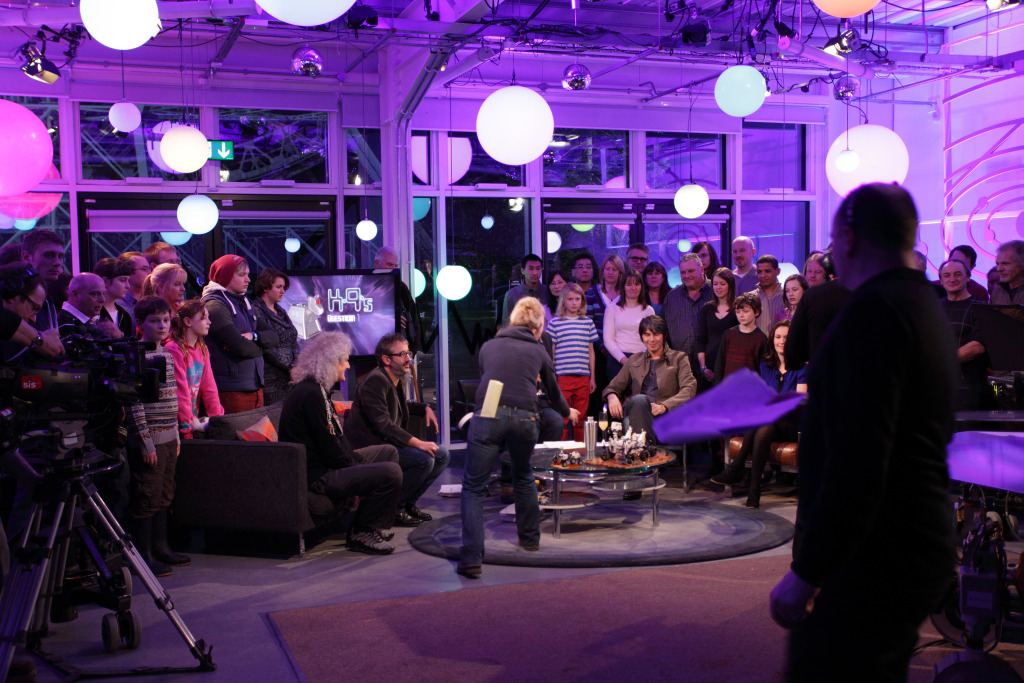
Image shows Dr. Brian May, David Baddiel, Dara O’Briain, Professor Brian Cox, Dr. Lucie Green and Dr. Lewis Dartnell during the broadcast of the first episode of the third series of ‘Stargazing Live-Back to Earth’ at Jodrell Bank.

Image shows Dr. Brian May, David Baddiel, Dara O’Briain, Professor Brian Cox, Dr. Lucie Green and Dr. Lewis Dartnell during the broadcast of the first episode of the third series of ‘Stargazing Live-Back to Earth’ at Jodrell Bank.
iPhone video of International Space Station pass, 17th February 2013 18:58 UTC
This is a short video of the ISS pass detailed here: http://www.heavens-above.com/passdetails.aspx?lat=53.41634&lng=-2.940475&loc=Liverpool&alt=10&tz=GMT&satid=25544&mjd=56340.7939304051&type=V
It was taken using an iPhone 4S without any modification or additional equipment. No zoom (digital or otherwise) was used.
The video isn’t the best quality, for the reasons above and because it was very much a last-minute decision to record it.
That said, I was pleasantly surprised that it turned out as well as it did!
I would recommend going to Full Screen mode, as this makes it a lot easier to see.
(Direct link to video: http://youtu.be/0ZszJWZlGNw )
Stargazing Live 2013 – Images from Derek Fox
Thanks to Derek Fox who has sent us some images from the Stargazing Live 2013 events at Jodrell Bank.