Sic Itur Ad Astra – Thus The Way To The Stars : 144 years of astronomy
If you can see this message then you are using a browser (probably Internet Explorer) which does not support the international web standards used by the LAS website and many others. Click here for an example of how the site should look.
Please consider using an alternative browser - especially if you are on Windows XP which only supports the outdated Internet Explorer 8 browser - such as Mozilla Firefox or Google Chrome which do have support for these web standards. As well as not supporting modern features and web standards, old versions of browsers - especially Internet Explorer - can expose your computer to security risks. The Browse Happy website has a list of the latest versions of all major browsers, including Internet Explorer (but remember Windows XP only supports up to IE8!)
If updating/changing your browser is not possible, do not panic - all of the LAS website is still available to you and we are working to make the layout compatible with outdated browsers.
A nice guide has been posted on the Active Astronomy website.
The guide is tailored for the southern UK but should be accurate enough for observers across the country too. Let us know in the comments or the forum if you saw the asteroid and what you thought!
You can also watch live images from robotic telescopes via the Slooh website here: http://events.slooh.com/#.UR6kjZk0e9w.twitter
On the Slooh website, use the left and right arrows above the circular area to change to views from different telescopes. The live broadcasts are at 22:00 UTC (15th February 2013) and 02:00 UTC (16th February 2013)
British Summer Time came into effect on 31st March 2013 – times below have been adjusted and are in BST!
(Click to enlarge) What’s visible in the sky above Liverpool in April 2013? Map is valid for: 1st April 2013 at 00:00 BST 15th April 2013 at 23:00 BST 30th April 2013 at 22:00 BST
The Sun
1st April 2013
6th April 2013
11th April 2013
16th April 2013
21st April 2013
26th April 2013
1st May 2013
Sunrise
06:45 BST
06:33 BST
06:22 BST
06:10 BST
05:59 BST
05:48 BST
05:37 BST
Sunset
19:47 BST
19:57 BST
20:06 BST
20:15 BST
20:24 BST
20:33 BST
20:42 BST
The Moon
Last Quarter
New Moon
First Quarter
Full Moon
Last Quarter
Date
3rd April 2013
10th April 2013
18th April 2013
25th April 2013
2nd May 2013
Time
05:37 BST
10:36 BST
13:32 BST
20:58 BST
12:15 BST
A partial eclipse of the Moon will take place on 25th April 2013, however only a sliver of the Moon’s Northern edge will enter the Umbral Shadow of the Earth, with the rest of the satellite in the Penumbra. This eclipse is not expected to be of note, other than that it is the 2nd shortest partial eclipse of the Moon of the 21st Century.
Eclipse Phase & Stage
Date
Time
Notes
Penumbral phase begins
25th April 2013
19:01 BST
This stage is not visible as the Moon is below the horizon
Umbral phase begins
20:51 BST
Maximum eclipse
21:07 BST
Umbral phase ends
21:23 BST
Penumbral phase ends
23:13 BST
Planets
Mercury
Mercury is poorly placed for the Northern Hemisphere during April.
Venus
Venus cannot be observed this month as it has only just passed Superior Conjunction.
Mars
Mars is another planet which cannot be seen this month due to its line-of-sight proximity with the Sun, as it reaches Solar Conjunction on May 18th 2013.
Jupiter
Jupiter is still visible in the constellation of Taurus (the bull), which is setting earlier now as the summer constellations come into play.
The Moon will pass less than 3° to the South of Jupiter on the night of the 14th April at about 21:00 BST.
Saturn
Saturn reaches Opposition on the 28th April 2013 and can be found in the constellation of Virgo (the virgin), and the planet is still tilted well enough to show the open ring system clearly.
Comets
Comet C/2011 L4 (Pan-STARRS) is fading after its close approach to the Sun, however it is visible in binoculars even in somewhat light-polluted skies.
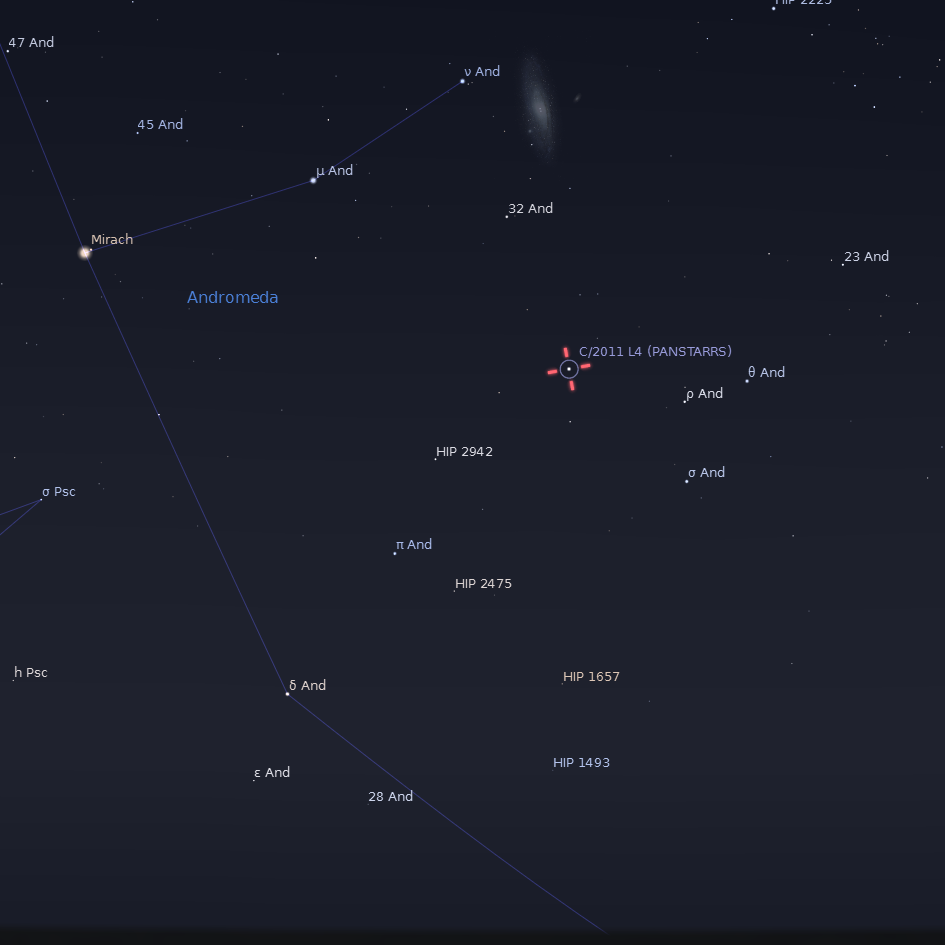
On 1st April at 22:00 BST the comet can be found just below the Andromeda Galaxy.
Comet C/2011 L4 (Pan-STARRS) position on 1st April 2013 at 22:00 BST
The comet is moving quite fast, having been flung by the Sun’s gravity and by mid-April it will be found to the lower-right of the “W” of Cassiopeia, however it may be more difficult to spot due to its increasing distance from the Sun and us, although its higher elevation in the sky may counteract this somewhat.
Comet C/2011 L4 (Pan-STARRS) position on 15th April 2013 at 22:00 BST
On the night of 20th April 2013, at about 02:40 BST, Comet Pan-STARRS will pass between the rightmost two stars of the “W” of Cassiopeia, Schedar (α-Cassiopeiae) and Caph (β-Cassiopeiae).
Meteors
Name of Shower
Date of Peak
Favourability
Notes
Virginid
12th April 2013
Favourable
New Moon occurs on 10th April 2013
Radiant is near Libra
A beautiful video of the moon rising from Mount Victoria, New Zealand, nothing much more I can say really, other than to make sure you watch it full-screen!
In order to make some room on the homepage, the features which were previously in the “Options” box on the left of the homepage can now be found in the menus above the page.
Registering, Logging In/Out and News Feeds are on the lower menu under the header (that is, below the LAS logo/astronomical image/search box).
You can edit your user profile (e.g. updating your e-mail address, etc.) by clicking on your username on the very top-right of the page.
A nice by-product of this rearrangement is that these are now available on all areas of the site, rather than just the homepage.
Try saying that with a gob-stopper in your mouth!
This is a pretty nice animation made from data of the Kuiper Belt objects which are currently candidates for the New Horizons spacecraft to fly-by after it’s been to Pluto.
Unfortunately due to bad weather, the BBC Stargazing Live event which was due to take place on Friday 25th January 2013 has been rescheduled to Friday, 22nd February 2013.
Just over seven years ago, on the 14th January 2005 at approximately 11:30 UTC, the Huygens probe (part of the Cassini-Huygens mission to Saturn) touched down on the surface of Titan.
The video below, released for the 5th anniversary of the probe’s touchdown, is a time-compressed montage of what was imaged as Huygens descended through the thick atmosphere of Titan over the course of about four hours. The sounds accompanying the video are representations of various data, such as the rotation of the probe and the strength of the radio signal between Huygens and the Cassini spacecraft.
In case the video won’t play for you, the full link is: http://youtu.be/PrnuGAQroXQ where you can also find a full description of what all the charts and sounds are.
Although it’s somewhat “old news” it’s still a fascinating video, and always brings to (my) mind the fleeting Venera images from Venus.
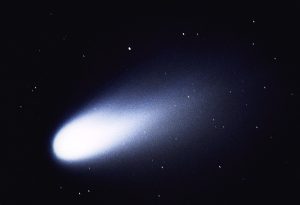
Comet Hale-Bopp taken by Tony Williams from Huyton, Merseyside on 22nd March 1997 at 20:30 UT. 10inch f4.3 Reflector Telescope,(prime focus), 2 min expos. Fujichrome Provia 400 (1600).
As alerted to us by LAS website user Brian on our Forums, this week’s episode of the Radio 4 “In Our Time” programme, hosted by Melvyn Bragg, covers the subject of comets.
You can listen in your browser or save the file to your computer for listening to on an MP3 player/transferring to iPod etc.
Melvyn Bragg and his guests discuss comets, the ‘dirty snowballs’ of the Solar System.
In the early 18th century the Astronomer Royal Sir Edmond Halley compiled a list of appearances of comets, bright objects like stars with long tails which are occasionally visible in the night sky. He concluded that many of these apparitions were in fact the same comet, which returns to our skies around every 75 years, and whose reappearance he correctly predicted. Halley’s Comet is today the best known example of a comet, a body of ice and dust which orbits the Sun. Since they contain materials from the time when the Solar System was formed, comets are regarded by scientists as frozen time capsules, with the potential to reveal important information about the early history of our planet and others.
With:
Monica Grady
Professor of Planetary and Space Sciences at the Open University
Paul Murdin
Senior Fellow at the Institute of Astronomy at the University of Cambridge
Don Pollacco
Professor of Astronomy at the University of Warwick
With the current popularity of astronomy due to programmes like BBC Stargazing Live there has been a marked increase in telescope sales. We regularly get requests from people struggling with their new purchases and we often find they have purchased something which is unsuitable for their needs – here at the Liverpool AS we are only too happy to help and advise on telescope purchases but we recommend that you come and talk to us first and hopefully get to look through some telescopes.
Our regular public Weekly Meetings are free to attend, and we also run various other public events such as Star Parties and open days. Keep an eye on our homepage, our Syllabus, or specifically the Events list to see if any are upcoming.
If you’re unable to visit, don’t worry – we can still help.
Please don’t be afraid to ask before you purchase something that may end up gathering dust in a loft or garage.
Please also check out our article, “Buying a Telescope” by LAS Member Steve Southern.
Comet ISON, first discovered out beyond the orbit of Jupiter, has people excited. Some are predicting that it may be the brightest comet seen for over a hundred years, however as any astronomer knows, that is a risky claim to make and one that can often turn out to be a gross over-exaggeration. Sometimes comets which promise dazzling displays can fizzle out with little warning – many will recall the relative disappointment of Comet Kohoutek in the 1970s. Comets are quite fragile things, and due to the nature of their composition, the very thing which gives them their beauty – the outgassing of their interiors and stripping of their nuclei by solar radiation – also destroys them. Comet ISON is a sungrazing comet, and as the name implies, it will pass very close to the Sun. This may tear the comet the apart, but if not, we may be treated to a spectacular sight – a comet which, when close to the sun can be seen in the daytime, and when it’s moved into the night time sky may even outshine the Moon.
Comet ISON is already on its way into the inner Solar System, and will be nearing the Sun towards the end of 2013. Let’s hope that it lives up to expectations – it could spark a new wave of interest, not just in comets specifically but in all aspects of the science and beauty of astronomy.
Tell us your thoughts by voting in the poll, and adding your comments below!